Pillow Certifications Explained: OEKO-TEX, GOTS, CertiPUR-US and GREENGUARD
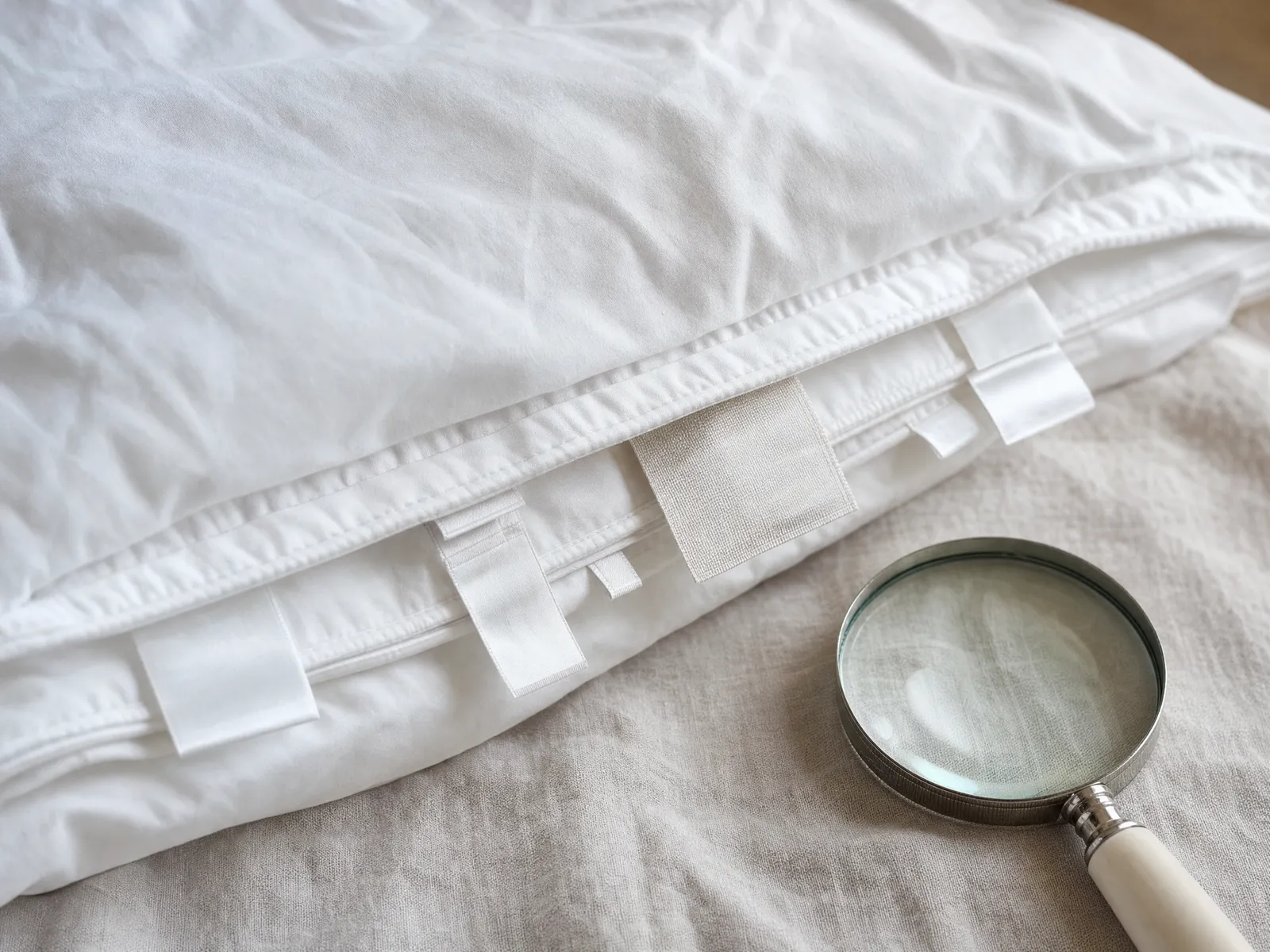
What do pillow certifications mean? Each one is a promise about a scope, not about a pillow. OEKO-TEX tests a finished textile against a chemical list. GOTS certifies fibre and supply chain. CertiPUR-US covers foam and nothing else. GREENGUARD Gold measures what a product puts into your air. None of them means "safe". We may earn a commission from links on this page, at no extra cost to you.
The gap between what a seal covers and what a shopper assumes it covers is where most disappointing bedding purchases happen. This article closes it. Below we compare the four certification families you will actually meet on a pillow listing, use four real pillows as worked examples of each, and finish with the two-minute habit that beats all of it: looking the certificate up yourself in the certifier's own database. If you would rather have a shortlist than a schooling, our guide to the best non toxic pillows is the place to start.
Certifications Certify Components, Not Pillows
A pillow is an assembly: an outer cover, sometimes an inner shell, a fill, plus thread, zips, dyes and finishes. A certification attaches to some of those parts, to a company, and to a date. It almost never attaches to "the pillow."
That explains most of the confusion. A listing titled "GOTS organic latex pillow" can be entirely accurate and still mean only that the cotton cover is certified — the latex core is a different material under different rules.
The second thing worth internalising is that these are tested-against-a-list claims, not absolute ones. OEKO-TEX is unusually blunt about this. Hohenstein, one of OEKO-TEX's partner institutes, states that certification indicates a product has been tested for the listed PFAS substances but does not certify it as "PFAS-free." That is the honest shape of every certification on this page.
So here is our house rule, and it is why you will not see the words "non-toxic pillow" used as a factual claim anywhere on this site: we will tell you what a pillow is made of and what a named third party has certified about it, and we will tell you what that certification does not cover. Anything beyond that is marketing.
The Four Certification Families, Compared
| Certification | What it certifies | What it does NOT cover | What the maker must do | Where to verify | | --- | --- | --- | --- | --- | | OEKO-TEX STANDARD 100 | The finished textile and its components, tested against a restricted-substance list of over 1,000 substances | Organic farming, animal welfare, emissions into room air; it is not a "PFAS-free" claim | Submit components and finished article for lab testing; certificates are valid one year | Label Check at oeko-tex.com, using the case-sensitive label number | | GOTS | Organic fibre content plus chemical inputs, wastewater, labour conditions across the whole production chain | Non-fibre components; a cover-only certificate says nothing about the fill | Every company in the chain must be certified by an approved independent certification body | Certified Suppliers database at global-standard.org, which shows each entity's scope certificate | | CertiPUR-US | Flexible polyurethane foam only: content screening plus VOC emissions under 0.5 ppm | Covers, non-foam fills, adhesives, other layers; PFAS is not on its published list | Foam samples tested by approved independent labs, twice in year one then annually, with random plant inspections | The directory at certipur.us, updated weekly | | GREENGUARD / GREENGUARD Gold | Chemical emissions into indoor air; Gold restricts more than 360 VOCs plus total emissions and requires CDPH Section 01350 compliance | What the product is made of, how fibres were grown, sourcing ethics | Chamber emissions testing against UL 2818 | UL Solutions' SPOT database at spot.ul.com | | Responsible Down Standard | Animal welfare and traceability of down and feather, farm to finished product | Chemistry, entirely — no substance testing of any kind | Audits at farms, slaughter facilities, processors and factories by accredited third parties | Textile Exchange's Find a Certified Company page |
One thing the table cannot show: every one of these is paid for by the manufacturer. That is normal for third-party conformity assessment, but it has a consequence worth holding onto. The absence of a seal is weak evidence. Plenty of small makers skip certification because testing and annual audits cost money, not because they have something to hide.
OEKO-TEX STANDARD 100: The Finished-Textile Baseline
This is the seal you will meet most often, and it is the most useful default. OEKO-TEX's own documentation describes STANDARD 100 as testing every component — every thread, button and accessory — against a list of over 1,000 harmful substances, with limit values reviewed at least once a year and certificates valid for one year at a time. Products are graded into four classes by how much skin contact they get, with Class 1 (baby and toddler articles) strictest and Class 2 covering direct-skin-contact goods such as bed linens.
On PFAS specifically, OEKO-TEX bans the intentional use of the substances across all of its certifications and, per Hohenstein, requires certified products to meet a limit of 25 ppb for each regulated PFAS substance from 1 January 2026. Its total fluorine limit is separately being cut from 100 ppm to 50 ppm during 2026, under the OEKO-TEX 2026 regulations that its own announcement says come into effect on 1 June 2026 after a three-month transition period. That is a genuinely strict number — and it is still a restricted-substance test rather than a guarantee, which is the distinction we unpack in our piece on whether pillows contain PFAS.
The LOFE Organic Pillow, 39.95 dollars as of August 2026, is our worked example because its listing is unusually honest about scope. The maker says the pillow meets OEKO-TEX Standard 100 and CPSC requirements and that the cover and inner shell are 100 percent organic cotton — while stating that the fill is polyester pearl fibre. Read the whole sentence and "organic" describes the shell, not the stuffing. Read the title only and you would guess otherwise.
CertiPUR-US and GREENGUARD Gold: Content Versus Emissions
These two get lumped together and they should not be. They answer different questions.
CertiPUR-US is about the foam. Its FAQ could not be clearer: "We only certify flexible polyurethane foam." Certified foam is made without formaldehyde, ozone depleters, phthalates regulated by the US Consumer Product Safety Commission, and mercury, lead and other heavy metals; it is screened for chemicals including flame retardants classified as carcinogens, mutagens or reproductive toxins; and it must show low VOC emissions of less than 0.5 parts per million. Note what is not on that published list: PFAS. Note also what is outside the scope entirely — the cover, the non-foam fill, the adhesives.
GREENGUARD Gold is about the air. UL Solutions describes GREENGUARD as a chemical-emissions certification, screening products against UL 2818 for VOCs that pollute indoor air. The Gold tier sets lower limits, restricts emissions of more than 360 VOCs plus total chemical emissions, and requires compliance with the California Department of Public Health's Section 01350 method — which is why it is the tier specified for nurseries, schools and healthcare settings.
The Coop Home Goods Original, 71.20 dollars as of August 2026 against a 89 dollar list price, shows the pairing in practice. According to Coop, the foam carries both certifications — content on one side, emissions on the other. Both, per the maker, attach to the foam. The cover is a separate component and the listing does not extend the seals to it.
GOTS: A Fibre Standard That Often Certifies Only the Cover
GOTS is the most demanding standard here and the one most often over-read. It covers every step of production, from fibre processing and spinning through wet processing, manufacturing and trading, and for a product to carry the label every company involved must be certified by an approved independent certification body. It has label grades: "Organic" requires 95 percent or more certified organic fibres, while "Made with x% organic materials" covers products at 70 to 94 percent. It also restricts what can be used in processing, and its criteria extend to wastewater treatment and labour conditions — ground no other certification on this page touches.
But GOTS is a fibre standard. It has nothing to say about a foam, a polyester fill, or a latex core.
The ORGANIC TEXTILES Natural Latex Pillow, 109.95 dollars as of August 2026, makes the point better than any explanation. The maker says its cover is GOTS certified organic cotton, removable and machine washable, and that its core is natural latex, sustainably harvested. The GOTS certificate the listing names covers the cotton. If you are shopping specifically for cotton or for latex, our guides to the best organic cotton pillows and to non-toxic latex pillows go deeper on each material than we can here.
Responsible Down Standard: Ethics, Not Chemistry
RDS is the odd one out, and the most misread. Administered by Textile Exchange, it covers the down supply chain from farms and slaughter facilities through processors and factories, banning live-plucking and force-feeding and requiring that certified down be traceable from farm to product, with certification carried out by accredited third parties.
It says nothing about chemistry. Not one substance limit. A down pillow can be fully RDS certified and carry a finish that RDS never looked at, because looking at finishes is not its job.
Which is precisely why the Pacific Coast Goose Feather and Down set, 74.99 dollars for two as of August 2026 against a 101.99 dollar list price, names two standards rather than one: the maker says the fill is certified to both RDS and OEKO-TEX. Animal welfare from the first, substance testing from the second. Its listing also carries a small lesson in label literacy — the maker notes that although the cover is 100 percent organic cotton, labelling rules mean it can only be printed as "100% Cotton." Sometimes the tag understates the case.
If down is what you are actually shopping for, our down pillow roundup covers fill power and construction in detail, and readers who like natural fills but not feathers usually end up in our wool pillow guide instead.
Is CertiPUR-US Enough? What No Label Covers
Here is the part most articles on this topic skip, and the reason we wrote this one.
A substance having hazardous properties is not the same as your pillow delivering a meaningful dose. Occupational and animal studies establish hazard. Whether a product in a bedroom produces exposure worth worrying about is a separate question needing its own measurements — and for bedding, those measurements are thin on the ground.
What we do have is suggestive and, honestly, reassuring. A 2022 study in Chemosphere collected 62 passive air samples over 32 days from two new memory foam mattresses in a simulated home environment. Emissions peaked right after installation and declined steadily over the following month; modelled one-year average concentrations came out at roughly 2.7 to 4.2 micrograms per cubic metre. The authors reported that the airborne concentrations they measured and modelled were well below available health-based benchmarks and concluded it was unlikely those mattress models would pose a health risk to consumers. A 2019 study in Environmental Science and Technology adds a caveat in the other direction: VOC emissions from polyurethane mattresses rose under simulated sleeping conditions, with body heat appearing to be the main driver.
Two mattresses are not every mattress, and a mattress is not a pillow. But that is the actual state of the evidence, and it does not support panic.
Regulation is similarly specific, and worth stating precisely rather than sweepingly. California's AB 1817 bans regulated PFAS in new textile articles — and the statute's own examples include bedding — with the ban effective 1 January 2025 at a threshold of 100 parts per million total organic fluorine, dropping to 50 ppm on 1 January 2027. New York's law took effect on the same date but applies to apparel rather than bedding. There is no nationwide US ban. Anyone who tells you flatly that "PFAS are banned in textiles" has left out the jurisdiction and the date, and we go through what that means for bedding in our piece on whether pillows contain PFAS.
Finally, the honest limits of any seal: certification describes audited production at a point in time, not the individual unit in your box, and it stops at the pillow. The case you put on it, the detergent you wash it in, and everything else in the room are outside every scope on this page. And if you have symptoms you associate with your bedding, the right next step is a clinician — not a different pillow.
How to Verify a Certification in Two Minutes
The most useful skill here is not memorising which seal covers what. It is checking. Every body on this page publishes a lookup:
- OEKO-TEX — Label Check on oeko-tex.com. Enter the label number; OEKO-TEX warns that label numbers are case sensitive, and the page also links a list of withdrawn certificates.
- GOTS — the Certified Suppliers database on global-standard.org, where each certified entity's scope certificate is available on its database entry. Entries are updated by GOTS-approved certification bodies.
- CertiPUR-US — the directory at certipur.us, a list of companies selling products containing certified foam, updated weekly.
- GREENGUARD — UL Solutions' SPOT database at spot.ul.com, which carries GREENGUARD and GREENGUARD Gold listings among other UL programs.
- RDS — Textile Exchange's Find a Certified Company page, built from data supplied by active certification bodies.
If a listing shows a seal but no number, ask the seller for the certificate or scope certificate number and the certification body that issued it. That one email sorts the real from the decorative faster than any amount of label reading.
The Bottom Line
Pillow certifications are useful and narrow. OEKO-TEX STANDARD 100 tells you a finished textile was tested against a long restricted-substance list. GOTS tells you about fibre and the chain that made it, and frequently covers only the cover. CertiPUR-US tells you about foam, full stop. GREENGUARD Gold tells you about emissions into air. RDS tells you about birds. Stack them and you get real, checkable information; read any one as a verdict on a whole pillow and you will be misled — usually by a claim that was technically true.
Our advice is calm and cheap to follow: decide which question you actually care about, find the seal that answers it, verify the number in the certifier's own database, and ignore the adjectives on the box. For the picks that come out of applying exactly that filter, Home Pillow Review's non-toxic pillow guide is the next thing to read. Sleep well — and let the certificate numbers, not the badges, do the talking.
The shortlist
4 pillows compared — firmness, loft, and temperature side by side. The top pick is highlighted.
| Pillow | Firmness | Loft | Sleeps | Best for | Price |
|---|---|---|---|---|---|
OEKO-TEX ExampleLOFE Organic Pillow 20x26 with Organic Cotton Case | Medium | Adjustable | Neutral | Certified cotton shell on a budget | $39.95 Check |
CertiPUR-US + GREENGUARD ExampleCoop Home Goods Original Adjustable Pillow (Queen) | Medium Firm | Adjustable | Neutral | Adjustable foam with third-party emissions testing | $71.20 Check |
Medium | Medium | Cooling | Natural materials and durability | $109.95 Check | |
Firm | Medium | Neutral | A down feel with traceable sourcing | $74.99 Check |
LOFE Organic Pillow 20x26 with Organic Cotton Case

I bought it for the certification and stayed for the zipper — pulling out about a third of the fill got me the flat-ish pillow I have been trying to buy for years.
It is noticeably smaller than my old standard pillow, and a normal pillowcase swims on it.
We include the LOFE because it is the clearest teaching example on this page of a claim that is true and narrower than it sounds. The maker says the pillow meets OEKO-TEX Standard 100 and CPSC requirements and is tested free of 100-plus harmful substances, and the cover and inner shell are 100 percent organic cotton. The fill, per the same listing, is polyester pearl fibre. So "organic" here describes the shell, not the stuffing.
Read that way it is a sensible budget pillow rather than a compromise. A side zipper lets you add or remove pearl fibre to change loft, and the maker recommends washing the cotton cover on its own so the fill does not clump. Check the dimensions before you order: at 20 by 26 inches it is smaller than a standard pillow, which surprises people more than any of the certification wording does.
Coop Home Goods Original Adjustable Pillow (Queen)

Took out two handfuls the first night and one more a week later, and it has held that shape since — the adjustability is the real feature, the seals are the reason I finally clicked buy.
Adjusting means unzipping and wrestling loose fill, and in a cold bedroom it wakes up firmer than it sleeps.
The Coop Original is the pillow we point to when someone asks what a double-certified foam looks like on a shelf. According to Coop, the foam is both CertiPUR-US and GREENGUARD Gold certified — one certification about what the foam is made of and screened for, the other about what it emits into the air of your room. The two answer different questions, which is exactly why makers pair them.
Underneath the labels it is a conventional adjustable pillow, and a good one. The fill is cross-cut memory foam blended with microfiber, and you add or remove it through a zipper to set loft and firmness; an extra bag ships in the box. Coop says it uses only freshly manufactured foam, never recycled, and notes that a cooler room can make the foam feel firmer. The certifications the maker names attach to the foam, not to the Lulltra cover around it.
ORGANIC TEXTILES Natural Latex Pillow with GOTS Organic Cotton Cover (Standard, Medium)

Three years in it has not developed the head-shaped crater my last two pillows did, and the cover comes off and washes like a pillowcase.
Latex has a springy push-back that takes adjusting to, and it is the most expensive pillow on this page by some distance.
This one exists on the page to make a single point stick: the GOTS certificate is on the cotton. The maker says the cover is GOTS certified organic cotton, removable and machine washable. The core is natural latex, which the maker describes as sustainably harvested — a different material, governed by a different set of standards, and not what the GOTS mark in the title refers to.
As a pillow it is a medium-loft, medium-firm latex sleeper with a pin-hole ventilated core the maker says improves airflow and keeps it cool, and the maker claims it resists the sagging and flattening common to other latex pillows. One practical warning straight from the listing: the latex core must not be machine washed. Wash the cover, air the core.
Pacific Coast Goose Feather and Down Pillows with Organic Cotton Cover (Standard, Set of 2)

The gusset keeps them from collapsing the way cheap down does, and knowing where the down came from was worth the price difference to me.
Firmer than I expected from a feather pillow, and the occasional quill still finds its way through.
Pacific Coast pairs two certifications that cover completely different ground, which is what makes it a useful example. The maker says the down and feather fill is certified to the Responsible Down Standard and to OEKO-TEX — the first is about how the birds were treated and whether the fill can be traced, the second about what the material was tested against. Neither one substitutes for the other.
The listing also contains our favourite small lesson in label literacy: the cover is 100 percent organic cotton, but the maker notes that labelling rules mean it can only be printed as "100% Cotton." The build is a double-layer feather-proof shell to stop quill leak, a 2-inch gusset, and a firm feel aimed at side and back sleepers, and the maker says the fill is washed and disinfected to remove allergens. It ships as a set of two.
The Five-Minute Certification Audit
Before you buy anything on the strength of a seal, run the listing through these five steps. It takes about five minutes and it is the only way to turn a marketing badge into a checkable fact.
One realistic caveat: these databases index companies and certified articles, not Amazon listings. You will often confirm that a maker holds a valid certificate for a product type rather than matching your exact SKU. That is still far better than taking the badge on faith.
Pillow Certification FAQ
Is CertiPUR-US enough? It depends what you want it to cover. CertiPUR-US says plainly in its own FAQ that it only certifies flexible polyurethane foam — not covers, not non-foam fills, not adhesives. As a statement about the foam it is meaningful; as a statement about the whole pillow it was never designed to be one.
Does OEKO-TEX STANDARD 100 mean a pillow is PFAS-free? No, and OEKO-TEX does not say it does. Hohenstein, an OEKO-TEX partner institute, states that certification indicates a product has been tested for the listed PFAS substances but does not certify it as "PFAS-free." OEKO-TEX does ban the intentional use of PFAS across its certifications, and from 1 January 2026 sets a limit of 25 ppb for each regulated PFAS substance; its total fluorine limit drops from 100 ppm to 50 ppm under the 2026 regulations, which OEKO-TEX says take effect on 1 June 2026.
What is the difference between GOTS and OEKO-TEX? GOTS is a fibre and supply chain standard: organic content, permitted chemical inputs, wastewater, labour conditions, verified annually at every certified company in the chain. OEKO-TEX STANDARD 100 is a finished-textile test against a restricted-substance list of over 1,000 substances. GOTS tells you how something was grown and made; STANDARD 100 tells you what was and was not found in it.
Is GREENGUARD Gold better than CertiPUR-US? They measure different things. CertiPUR-US covers foam content plus a VOC emissions limit under 0.5 parts per million. GREENGUARD Gold is an emissions certification for the product's contribution to indoor air, requiring compliance with the California Department of Public Health Section 01350 method. "Better" only makes sense once you decide whether you care about what is in the material or what comes out of it.
Does RDS say anything about chemicals? No. The Responsible Down Standard is an animal welfare and traceability standard administered by Textile Exchange, covering the supply chain from farms and slaughter facilities through processors and factories. It bans live-plucking and force-feeding. It has nothing to say about what is in the fabric.
Are PFAS banned in bedding? Only in some places, and the detail matters. California's AB 1817 bans regulated PFAS in new textile articles, and the statute's examples include bedding; it took effect on 1 January 2025 at 100 parts per million total organic fluorine, dropping to 50 ppm on 1 January 2027. New York's law took effect the same day but covers apparel, not bedding. There is no nationwide US ban.
I think my bedding is making me feel unwell. What should I do? Talk to a clinician. We can help you read a label; we cannot tell you what is causing a symptom, and no pillow is a treatment.
Why you can trust us

Aimee Cannon
Sleep & bedding writer
Aimee Cannon is a sleep and bedding writer who has spent years testing pillows of every kind — memory foam, down, wool, bamboo, buckwheat, and specialty support pillows. She focuses on matching the right pillow to each sleeping position and need, and reports what actually holds up after months of nightly use. When she is not testing pillows, Aimee is usually with her husband and her dog.