Humidity and Dust Mites: The Number That Matters
Hold relative humidity between 35% and 50%. That is the figure the 2013 AAAAI/ACAAI dust mite practice parameter recommends, at a strong recommendation on B evidence. But if you searched for what humidity kills dust mites, the pedantic answer matters: ordinary household dehumidification mostly suppresses mite survival and reproduction rather than killing a population outright. We may earn a commission from links on this page, at no extra cost to you.
The number is the easy part. Holding it is not, and that is the rest of this page: the thresholds underneath the range, why a good daily average can still feed a thriving colony, and why the trial record for dehumidifiers is thinner than the hardware aisle implies. If you would rather start from a shortlist, our guide to the best pillow for allergies runs this evidence over a set of picks.
What humidity kills dust mites — and what it only slows
Summary statement 10 of Environmental Assessment and Exposure Control of Dust Mites, published by Portnoy and colleagues in Annals of Allergy, Asthma and Immunology for the AAAAI and the ACAAI: "Advise patients that relative humidity in the home should be kept at 35% to 50% to decrease the growth of dust mites." Strong recommendation, B evidence.
Notice the verb: "decrease the growth of", not kill. In air below their tolerance, the parameter says, mites "slowly lose water", though "they may survive for weeks before they die", and "a dehydrated mite can regain water within a few hours if the RH increases above the critical equilibrium humidity, even if only for a short time." Dermatophagoides farinae, one of the two commonest species in temperate US homes, "is particularly resistant to desiccation and can survive for many months in low humidity conditions."
A dry bedroom is hostile, then. Not lethal.
Why dust mites care about humidity at all
They cannot drink. According to the parameter, "house dust mites are about 75% water by weight and do not drink or urinate." They maintain water balance "through uptake of water vapor when the RH is at least approximately 65%", and "experience water loss by evaporation when the surrounding RH decreases below approximately 55%".
The organ is named too: the supracoxal glands, at the base of the first pair of legs, which concentrate sodium and potassium chloride to "osmotically absorb water vapor from the environment" — and which, the parameter says, "can maintain a positive water balance only at an ambient RH of at least 50%." Humidity is not a comfort setting for a mite. It is the tap.
The dust mites humidity level, threshold by threshold
Four numbers from the same document, and they are not interchangeable:
- 65% and above. "Mites require RH higher than 65% to prevent water loss and to thrive."
- Below about 55%. Water starts leaving the mite by evaporation.
- Below 50%. "Decreased survival and reproduction." An RH under 50%, the parameter adds, puts water activity in upholstered furniture and bedding "below that which dust mites require for survival" — and above 50%, "abatement should be performed".
- Below 35%, for at least 22 hours a day. The figure for complete prevention: the parameter cites a study in which that was what it took "to completely prevent the growth of D farinae".
The band also has a floor, for human reasons rather than mite ones: the parameter notes that air which is too dry, under 25% RH, "can serve as a respiratory irritant".
Spikes defeat averages
This is what most humidity advice leaves out. The parameter: "Houses which are kept dry most of the time can still harbor living dust mites if the RH increases for as few as 1.5 hours per day, as would occur during cooking. As few as 3 hours per day of elevated humidity enables dust mites to produce eggs."
Ninety minutes. A long shower, a pan of pasta, a rack of washing in the bedroom.
It is not all-or-nothing: the parameter reports that daily humidity held below 50%, "even with brief increases above 50% for 2 to 8 hours daily", still decreased mite growth and allergen production. Partial control buys a slower colony, not no colony — but the metric is hours in band, not the daily mean, and one spot reading is a sample rather than a measurement.
Does a dehumidifier for dust mites work? The trials say less than the box does
If you are about to spend $200, read this twice. The parameter's own review: "studies of humidity control using portable and central dehumidifiers have failed to decrease mite exposure, in part because of the difficulty in obtaining adequate humidity decreases and because even brief periods of elevated humidity are sufficient to sustain mite populations."
The trials behind that sentence:
- Portable units, northwest England. Six homes received portable dehumidifiers, six served as controls. "Unfortunately, humidity did not decrease enough to retard mite growth." No difference in mite counts or Der p 1 levels at one, two and three months.
- Whole-house systems. Heat-recovery ventilation units in 18 houses, measured quarterly for a year: "No differences in Der p 1 concentrations or mite counts were found in any of the sampling sites." Enhanced central dehumidification in 10 houses against 10 controls did succeed on the hygrometer — winter humidity fell from 50% to 37%, below the 45% study target — and still "failed to decrease mite exposure despite apparently adequate humidity control."
Then the counter-example, because flattening it would be dishonest. In a humid temperate climate, the parameter reports, holding indoor humidity below 51% through the summer did work: those homes went from 401 live mites per gram of dust to 8 per gram after 17 months, while controls that relied on opening windows showed no decrease. The clinical layer sits lower again — Singh and Jaiswal's 2013 Cochrane review Dehumidifiers for chronic asthma found only two qualifying randomised trials, and Cochrane's summing-up is that "current evidence shows little clinical benefit from the use of dehumidification using mechanical devices on the clinical status of asthma patients".
Two documents, one appliance, different questions. The parameter's cost table still lists a dehumidifier at $204 to $414 among interventions "that have been shown to be effective", and the strong recommendation attached is to the 35% to 50% target rather than any machine. AAFA says plainly: "Use dehumidifiers to reduce both mold and dust mites." We would rather show you that spread than pretend half of it away.
Bedroom humidity, allergies and why the published ranges overlap
Three ranges, two agencies, slightly different questions:
- The EPA's guidance on biological pollutants states that "a relative humidity of 30-50 percent is generally recommended for homes", and separately that "maintaining the relative humidity between 30% - 60% will help control mold, dust mites and cockroaches."
- The EPA's Mold Course frames it as a ceiling with a preference: "Indoor relative humidity (RH) should be kept below 60 percent -- ideally between 30 percent and 50 percent, if possible."
- The practice parameter is tightest, at 35% to 50%.
The overlap is 35% to 50%, which is where to set a dehumidistat. The EPA's wider band is general indoor-air advice covering mould and cockroaches as well as mites; the parameter's is aimed at a mite-allergic patient's bedroom. Not in conflict, just different jobs.
Buy the hygrometer before anything else
Summary statement 9: "Encourage dust mite-allergic patients to obtain and use a hygrometer to measure humidity in their home." Strong recommendation, candidly on D evidence. The parameter calls it "an inexpensive device" and its cost table puts a temperature/hygrometer at $7.50 to $33.00 against $204 to $414 for a dehumidifier. AAFA's version is three words: "Use humidity monitors."
Use it properly: "Monitoring RH is not as simple as placing a hygrometer in the middle of a room." The parameter reports that relative humidity "can vary from 30% to 50%, in the same house, at the same time", that RH near a cooler floor runs higher than near a warmer ceiling, and that humidity builds where air does not move. Move the instrument around, across seasons.
If your bedroom reads 42% all week in more than one spot, humidity is unlikely to be the lever here, and a dehumidifier is unlikely to become the answer. Our guide on how to prevent a dust mite allergy ranks the other measures by the grades the specialists put on them.
Where bedroom moisture actually comes from
The parameter's moisture appendix names the sources, and most of them are you: the overlooked ones are those "generated by the occupants", including "cooking, showers, drying clothes, and cleaning and the number of house plants". Then the arithmetic that sets the reading: "If the amount of moisture exceeds the amount removed by ventilation, then the absolute humidity inside the house increases."
Which makes the first fixes close to free:
- Ventilate deliberately after a shower or a long cook. The parameter advises that "the house should be regularly ventilated to remove humid air" and that air circulate between rooms. An extractor fan left running past the end of the shower is the cheap version of that.
- Stop drying laundry in the bedroom. A load evaporates into whichever room it dries in, and "drying clothes" is on the parameter's own list.
- Match the tool to the weather. "To lower indoor humidity during warm, humid weather, air conditioners and/or dehumidifiers should be used," says the parameter; AAFA agrees on the cheaper half, "use air conditioning in warm weather to control dust mites and reduce humidity".
None of it costs $204, and all of it comes before the appliance.
Room air versus the inside of a pillow
A hygrometer on the nightstand measures the room. Mites do not live in the room. According to the parameter they are photophobic and "live deep within soft substrates, such as pillows, mattresses, and carpets, where moisture is retained and humidity fluctuations are minimized" — steadier and damper than the air above. Its appendix adds that above 65% RH the hygroscopic dust and lint in those materials "gain enough moisture to support the growth of some fungi and mites."
So does a room reading mean anything inside a pillow? More than we expected: the parameter cites a study which found "humidity inside beds did not increase when the beds were occupied because the temperature increased at the same time", and concludes that "whole-house humidity control also may be effective to control dust mites in beds."
We would rather print that tension than resolve it. What is in that reservoir is the subject of dust mites in pillows.
Seasons, climates and damp flats
This is weather-dependent work, and the calendar changes the job.
- Winter in a cold climate. The parameter notes that homes in temperate climates have low humidity in the winter months, so decreasing humidity "is more important during the summer months owing to increased RH". Heated winter air often sits under the band unaided — which makes running a humidifier up to a comfortable 50% in January a decision with a cost attached.
- Summer in a humid climate. Where the fight is real, and where the one trial above that worked was run. In a seasonal study the parameter describes, Der f 1 and Der p 1 levels "increased from August to peak in September and October and then decreased through June".
- Flats are not houses. The same study found mite allergen in beds "19 times higher in houses than in apartments", with apartments showing the lowest humidity. A damp ground-floor flat is still damp, but the building type does some of the work for you.
Mould is the same problem with a different organism — the quiet argument for bothering at all. The EPA's Mold Course puts dust mites inside guidance aimed at fungi — "low humidity may also discourage pests (such as cockroaches) and dust mites" — and AAFA compresses the pair into one sentence: "Reducing humidity decreases dust mites and mold growth." One dehumidistat setting serves both. We have a separate article on mould in pillows coming, because the cleanup differs even where the cause does not, and another on whether air purifiers help with dust mites.
Why the encasement stays regardless
Humidity control is slow, partial and weather-dependent. A barrier is none of those things.
Summary statement 17: "Recommend that patients should use mite allergen-proof mattress, box spring, and pillow encasings to decrease exposure to mite allergens." Strong recommendation, B evidence — the same grade as the humidity target. AAFA goes further: "Encasing mattresses works better than air cleaners to reduce allergy symptoms."
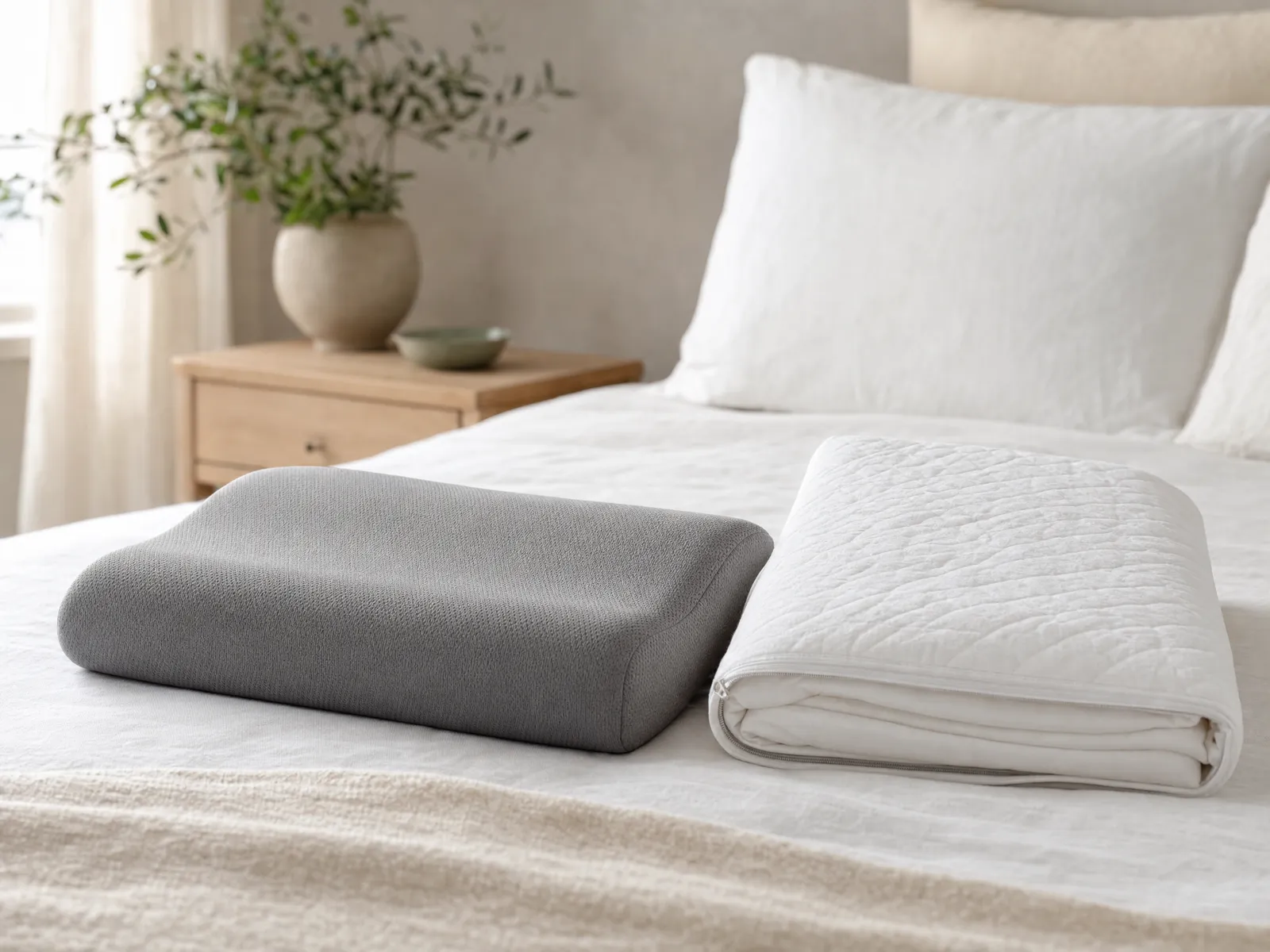
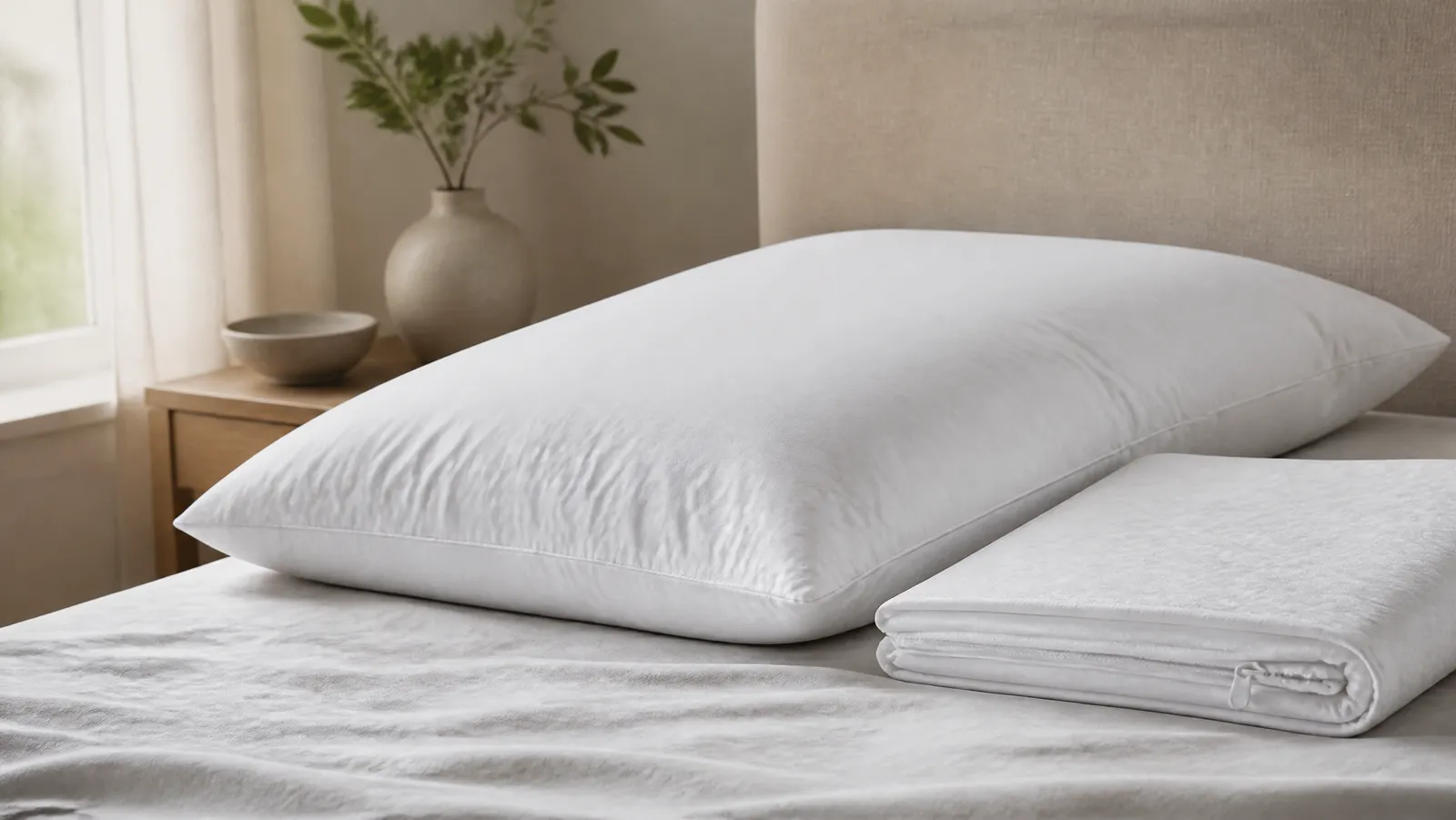
Our pick is the Mission: Allergy Barrier II pillow encasing at $24.95 as of October 2026, the only cover we have reviewed with a named third-party test on the listing: Mission: Allergy states it is medical grade, blocks 100% of dust mite and animal dander allergens, and was third-party tested by Indoor Biotechnologies, Inc. No mean pore size is published — the parameter's specification is woven microfibre under 10 micrometres — so we report the test, not the figure. More on that line in our guide to dust mite pillow protectors.
If the problem is a damp flat rather than one bed, the arithmetic matters: the AllerEase Premier zipper pillow protectors are $21.49 for four as of October 2026 — $5.37 a cover. No pore size, no named test, so we will not call them allergy-proof — and we cannot show you that an untested cover blocks Der p 1 the way the parameter’s 10-micrometre specification does; but we would rather see a zippered cover on every pillow than one tested cover and three bare ones.
And in a room you cannot hold below 50%, the pillow itself has to be washable, because weekly washing is the other strong, B-evidence recommendation: statement 13 advises washing bedding weekly "and that high temperature is not necessary", with home hot water kept below 120°F for scald safety. Most pillows quietly opt out. The downluxe down alternative pillows, two for $29.98 as of October 2026, are here because downluxe states they are machine washable — a laundry claim, not an allergen one. The other half of that job is how to remove dust mites from pillows.
The bottom line
What humidity kills dust mites? Practically, nothing you will run in a bedroom. What 35% to 50% relative humidity does, according to the practice parameter, is decrease growth, survival and reproduction — and the document's highest-graded avoidance advice, summary statement 21, is a multifaceted approach rather than any single lever, at moderate recommendation on A evidence.
So: measure first, with a $7.50-to-$33.00 instrument, in more than one spot and season. Fix the moisture you generate before buying a machine. Judge yourself on hours in band rather than a flattering average, since 1.5 hours a day of elevated RH is enough to keep mites alive. Treat a dehumidifier as a plausible tool with a patchy trial record, not a cure. Keep the encasement either way — and if you would rather start from picks, our guide to pillows for allergy sufferers ranks them on this same evidence.
One last thing, because this is a health page and not a hardware page. Allergy and asthma are medical conditions, and the parameter itself suggests further measurement when symptoms persist despite reasonable efforts. If you wake up congested most mornings, a clinician who can test and treat you is a better next step than a dehumidifier.
The shortlist
3 pillows compared — firmness, loft, and temperature side by side. The top pick is highlighted.
| Pillow | Firmness | Loft | Sleeps | Best for | Price |
|---|---|---|---|---|---|
| — | — | Neutral | Putting a tightly woven encasing on the pillow you already own | $24.95 Check | |
Lowest Cost Per CoverAllerEase Premier Zipper Pillow Protector, Standard/Queen, 4 Pack | — | — | Neutral | Getting a zippered cover onto every pillow in the house at once | $21.49 Check |
Best Washable Pillow Pairdownluxe Down Alternative Pillows, Standard 20x26, Set of 2 | Medium Soft | Medium | Neutral | A washable synthetic pillow you can replace often | $29.98 Check |
Mission: Allergy Dust Mite and Allergen Proof Pillow Encasing (Cover); Barrier II (Standard Size)
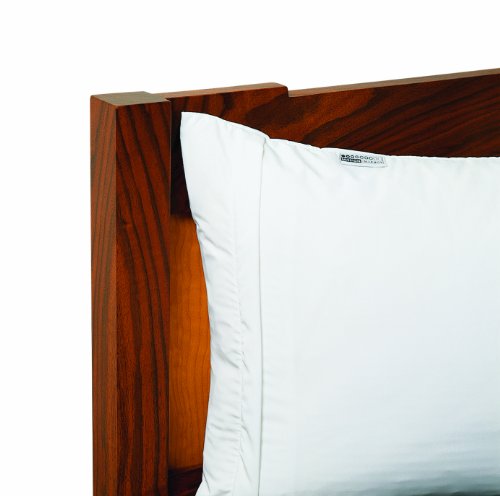
It is the only encasing here with a named third-party allergen test behind it, it is the woven construction the practice parameter endorses rather than the non-woven kind it warns against, and it does not care what your hygrometer says this week.
The 100% blocking figure is the maker's own commissioned result with no mean pore size published on the listing, and at $24.95 as of October 2026 this is one standard cover, not a bed.
Humidity control is slow, weather-dependent and, on the practice parameter's own reading of the trials, unreliable. A barrier is none of those things. The 2013 AAAAI/ACAAI parameter grades mite allergen-proof mattress, box spring and pillow encasings a strong recommendation on B evidence — the same grade it gives the 35% to 50% humidity target — and specifies woven microfibre with a mean pore size smaller than 10 micrometres to block Der p 1. Mission: Allergy states this encasing is medical grade, blocks 100% of dust mite and animal dander allergens, and was third-party tested by Indoor Biotechnologies, Inc. No pore size is published, so we report the test, not the number. $24.95 as of October 2026 buys one standard cover.
AllerEase Premier Zipper Pillow Protector, Standard/Queen, 4 Pack

At $5.37 a cover it is the cheapest per-unit way we know to get a zippered, hot-washable protector onto every pillow in a damp house at once.
No mean pore size and no named third-party test, so the allergy framing rests on the words "tightly woven" — and the wash-hot, dry-cool instruction is easy to reverse.
Damp is rarely confined to one bedroom, and a cover on one bed out of three leaves most of the reservoir uncovered. So say the arithmetic out loud: $21.49 as of October 2026, down from a $27.99 list price, for four protectors is $5.37 a cover — the lowest cost per cover we have found, which is not the same as the cheapest pack. AllerEase states the fabric is tightly woven and designed to fully protect the pillow. The care instruction reverses halfway through: machine wash hot with non-chlorine bleach when needed, then tumble dry on the lowest setting. What you do not get is a number — no mean pore size, no named third-party test.
downluxe Down Alternative Pillows, Standard 20x26, Set of 2
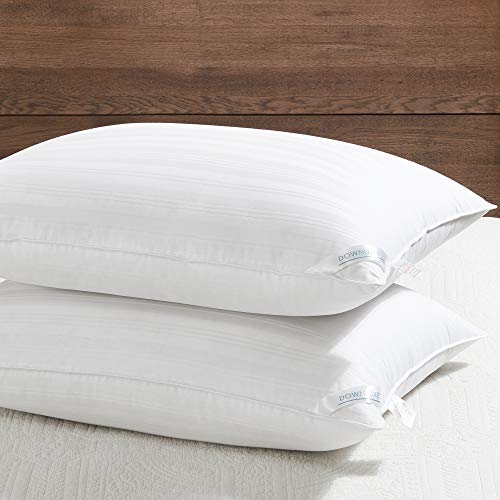
The maker states the pillows are machine washable, which is what makes them compatible with the weekly-washing recommendation, and two for $29.98 as of October 2026 keeps replacement affordable.
No allergen test, pore size or mite claim of any kind attaches to the fill, and roll-packing means waiting a day after unpacking before you can judge the loft.
Weekly washing is the other strong, B-evidence recommendation in the practice parameter, and in a room you cannot hold below 50% it is doing more of the work. It carries an unstated precondition: something in the bed has to survive a wash, and most pillows do not. downluxe states these are "machine washable to easily ensure your pillows are always fresh and clean", with a polyester blend down-alternative fill at a standard 20 by 26 inches, roll-packed with 24 hours recommended for the shape to recover. Two for $29.98 as of October 2026, against a $36.99 list price. Nothing on the listing says the fill resists mites, moisture or mould.
Holding 35% to 50%, Cheapest Step First
Humidity control is the one bedroom measure where the cheap step and the well-evidenced step are the same step. This is the order we would work in, with what each stage rests on.
Humidity and Dust Mites FAQ
What humidity level kills dust mites? Strictly, household humidity control suppresses rather than kills. The 2013 AAAAI/ACAAI practice parameter recommends 35% to 50% relative humidity "to decrease the growth of dust mites", and describes mites in drier air as slowly losing water while "they may survive for weeks before they die". For complete prevention of Dermatophagoides farinae growth, it cites a study in which RH had to be held below 35% for at least 22 hours per day.
Why does humidity matter so much to a mite? It is their water supply. According to the parameter, house dust mites "are about 75% water by weight and do not drink or urinate", and obtain water "through uptake of water vapor when the RH is at least approximately 65%". The organs responsible are the supracoxal glands at the base of the first pair of legs, which "can maintain a positive water balance only at an ambient RH of at least 50%".
Is 50% safe or not? It is the edge. The parameter states that mites show "decreased survival and reproduction with an RH below 50%", and that in general an RH lower than 50% corresponds to water activity in bedding and upholstery "below that which dust mites require for survival" — adding that if humidity is higher than 50%, "abatement should be performed".
Will a dehumidifier fix it? Sometimes, and the trial record is poor. The parameter reports that studies using portable and central dehumidifiers "have failed to decrease mite exposure", describes a northwest England trial in which portable units in six homes did not lower humidity enough to retard mite growth — no difference in mite counts or Der p 1 at one, two and three months — and a central system that cut winter humidity from 50% to 37% yet "failed to decrease mite exposure despite apparently adequate humidity control". One study did work: homes held below 51% RH went from 401 live mites per gram of dust to 8 per gram after 17 months.
Why do the EPA and the allergy guideline quote different ranges? They answer different questions. The EPA states that "a relative humidity of 30-50 percent is generally recommended for homes" and that "maintaining the relative humidity between 30% - 60% will help control mold, dust mites and cockroaches"; its Mold Course puts it as "below 60 percent — ideally between 30 percent and 50 percent, if possible". The parameter's 35% to 50% is the tightest of the three. The ranges overlap there.
Does a bedroom reading tell me what is happening inside the pillow? Partly. The parameter notes that mites live "deep within soft substrates, such as pillows, mattresses, and carpets, where moisture is retained and humidity fluctuations are minimized", and that dust and lint in those materials are hygroscopic — above 65% RH they "gain enough moisture to support the growth of some fungi and mites". But it also cites a study which found humidity inside beds did not increase when the beds were occupied, because the temperature rose at the same time, and concludes that whole-house humidity control "also may be effective to control dust mites in beds".
Should I be doing this in winter? In a cold climate, often not. The parameter notes that homes in temperate climates have low humidity during the winter months, so decreasing humidity "is more important during the summer months owing to increased RH". In a seasonal study it describes, Der f 1 and Der p 1 levels "increased from August to peak in September and October and then decreased through June".
Does fixing humidity mean I can stop using covers? No. The parameter grades encasings a strong recommendation on B evidence, the same grade as the humidity target, and AAFA states that "encasing mattresses works better than air cleaners to reduce allergy symptoms". Humidity control is slow, partial and weather-dependent; a barrier is not. If symptoms persist despite reasonable effort, that is a question for a clinician rather than another appliance.
Why you can trust us

Aimee Cannon
Sleep & bedding writer
Aimee Cannon is a sleep and bedding writer who has spent years testing pillows of every kind — memory foam, down, wool, bamboo, buckwheat, and specialty support pillows. She focuses on matching the right pillow to each sleeping position and need, and reports what actually holds up after months of nightly use. When she is not testing pillows, Aimee is usually with her husband and her dog.