Mold in Pillows: How It Starts and What to Do
Mold in pillows starts with water that never left. Something soaked the pillow — a wash that never dried to the core, a head that went to bed damp, a cold exterior wall behind the headboard, a season in a damp loft — and the fill stayed wet long enough for fungi to take hold. A pillow with growth through the fill is a replacement, not a laundry project. We may earn a commission from links on this page, at no extra cost to you.
That second claim is guidance, not preference. The US Environmental Protection Agency's household mold advice states that absorbent or porous materials, "such as ceiling tiles and carpet, may have to be thrown away if they become moldy", because mold fills in the crevices of porous materials, so it "may be difficult or impossible to remove completely". A pillow is about as porous as a household object gets. Which is why the picks here are cheap washable pillows and a washable cover rather than a cleaning spray: the cover is the part you launder, the pillow is the part you replace. If you landed here because of morning congestion rather than a stain, our guide to the best pillow for allergies ranks the bedroom measures the allergy guidelines actually grade.
Can mold grow in pillows? Three requirements, all of them met
Fungal growth needs moisture, something organic to feed on, and time. A wet pillow supplies all three.
Moisture is the only variable you control. According to the EPA's mold course, "to grow indoors, mold needs moisture and food", and its homeowner guide is blunter about the first: none of the molds found indoors "will grow without water or moisture". The same guide notes that it is impossible to get rid of all mold and mold spores indoors. The spores are already in your bedroom; what you decide is whether they get a drink.
Food is not a constraint. The EPA states that "mold can grow on virtually any organic substance", listing paper, cloth, wood, plant material and soil. A pillow is cloth, often over a natural fill, and it collects skin, hair and body oils.
Time is shorter than people expect. The EPA's guidance is to dry water-damaged areas and items within 24 to 48 hours to prevent mold growth. That is the window.
The 2013 AAAAI/ACAAI practice parameter Environmental Assessment and Exposure Control of Dust Mites, published by Portnoy and colleagues in Annals of Allergy, Asthma and Immunology, adds the bedding detail: it describes the dust and lint gathered in carpets, mattresses and pillows as hygroscopic, and states that if relative humidity rises above 65%, "these materials gain enough moisture to support the growth of some fungi and mites". A pillow in a damp room is a sponge.
What causes mold in pillows: the five routes water takes
- A wash that never dried to the core. This is the one we would warn about first, because the pillow lies to you: the cover feels dry while the centre is still wet. The Sleep Foundation's washing guidance says a pillow may need extra time in a tumble dryer "to dry the interior fill, even if the cover feels dry", and that it is important to let a pillow dry fully before using it.
- A damp head and a sweaty night. A sleeper is a moisture source, and a pillowcase is the only thing in the way. Going to bed on wet hair is the version you can stop doing.
- Condensation on something cold. The practice parameter explains the physics: moisture migrates from warm areas of a home toward cooler ones, and cold surfaces such as exterior walls on the north side of a house can condense water. A headboard against a cold outside wall is a condensation trap.
- A chronically damp room. The same document recommends dehumidifiers in chronically damp areas such as basements and crawlspaces to hold humidity below 60%.
- Storage. A pillow bagged up damp in a loft or garage has moisture, food and all the time it needs.
Mold or mildew — and what growth on bedding actually looks like
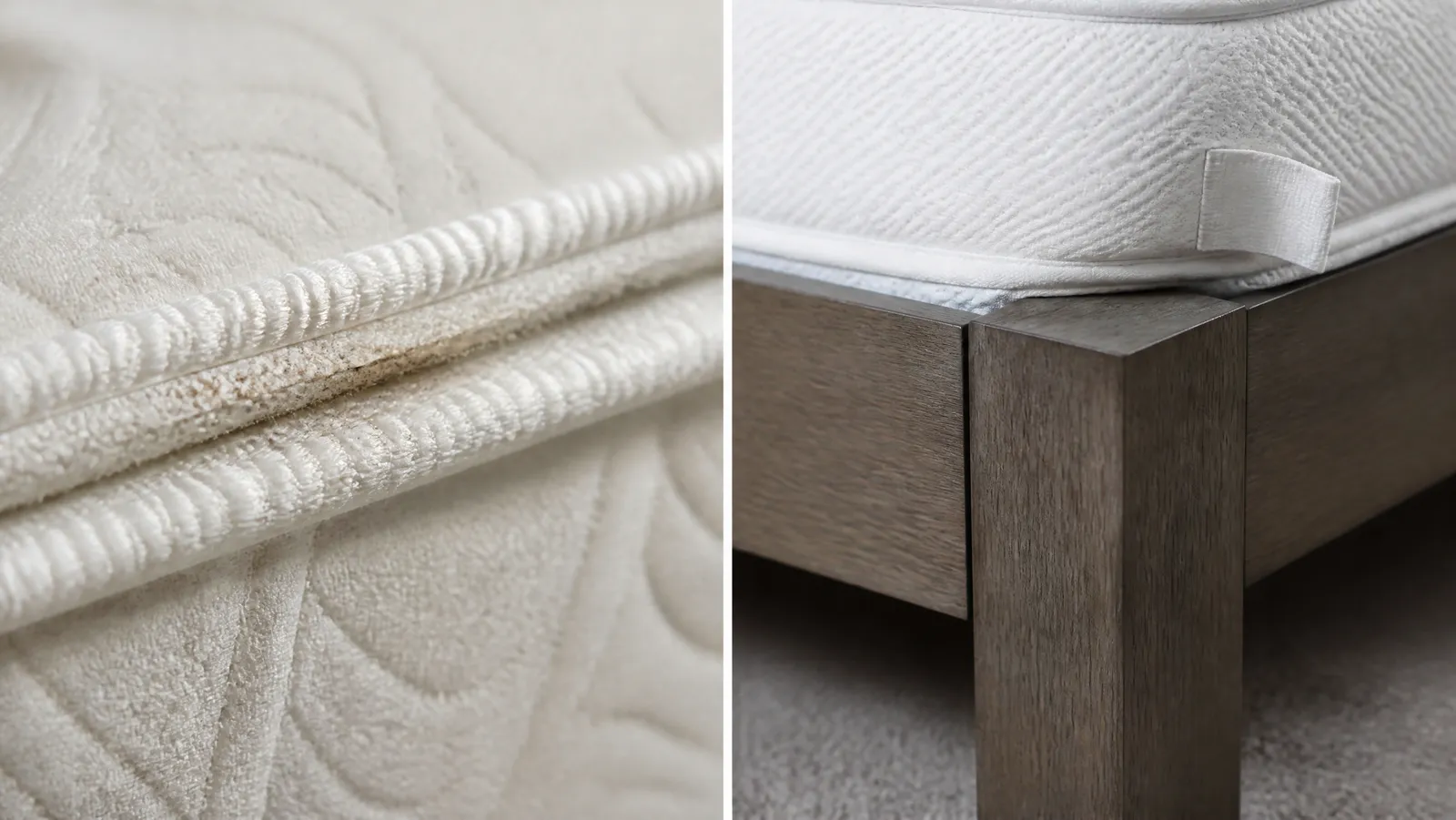
The terminology is looser than the arguments about it. The EPA's mold course opens by calling molds "fungi or mildew" and placing them in the kingdom Fungi — the agency uses mildew as another word for mold. Everyday use reserves "mildew" for flat, powdery growth on a surface and "mold" for the fuzzy kind that has got into the material, but we found no federal definition separating them.
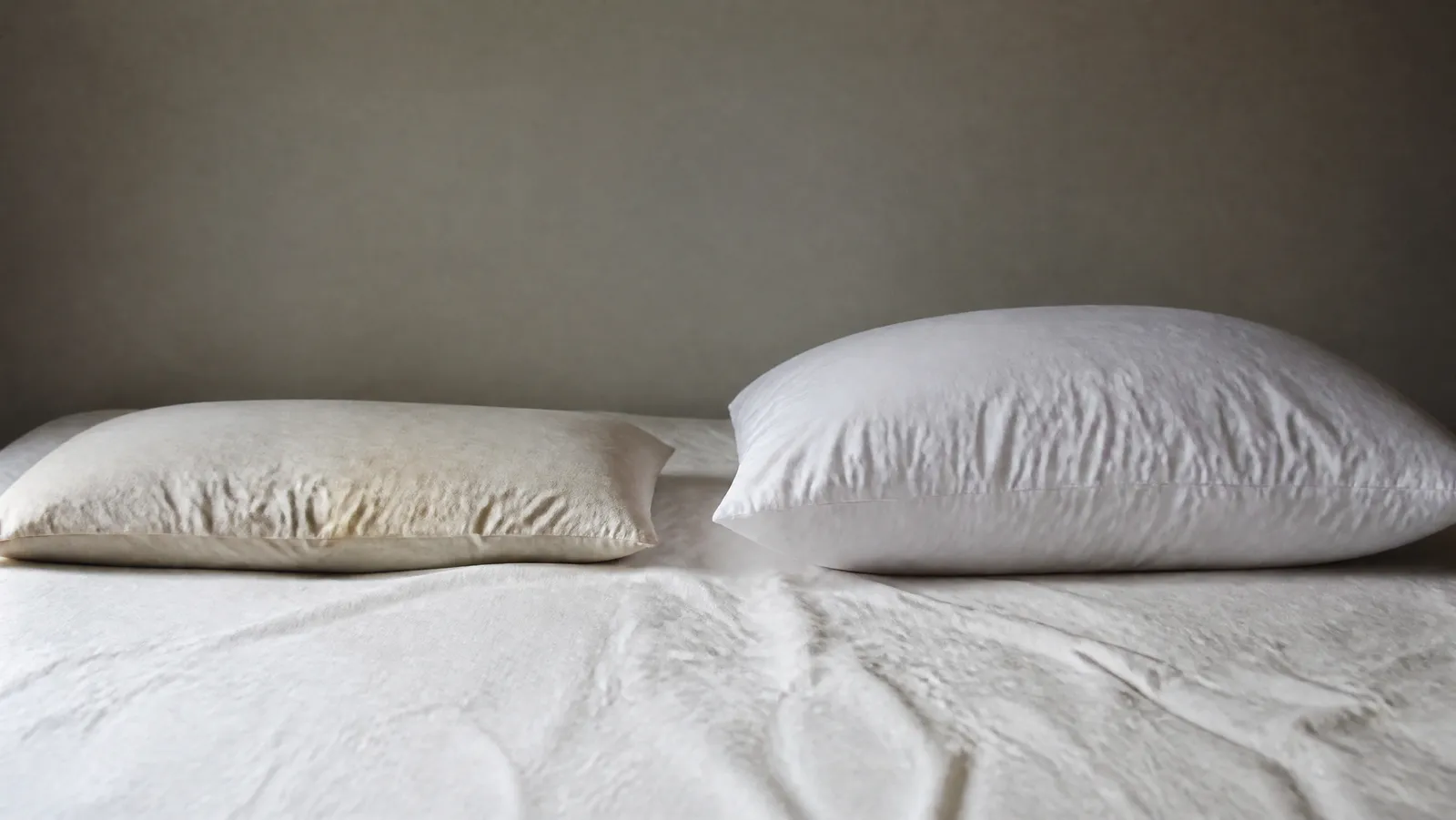
What to look for is simpler. Massachusetts' Department of Public Health, summarising EPA guidance, states that visual evidence of mold growth and/or musty odors are reliable indicators of a problem. The smell usually arrives first, and the practice parameter lists "musty or mildew odor" and higher bedroom humidity among the factors associated with increased dust mite allergen exposure. Colour, by contrast, tells you nothing.
Can you wash mold out of a pillow? Mostly no
This is the answer the search results bury under stain-removal tips. The EPA's position on porous materials with mold growth is disposal rather than cleaning, because the growth penetrates the material instead of sitting on top of it — in the agency's words, the mold "may be difficult or impossible to remove completely". Massachusetts DPH, following the same guidance, puts it flatly — materials that absorb water and become moldy cannot be adequately cleaned and should be discarded. A pillow is the most absorbent object in the bed.
Two qualifications. We found no published laundering trial for pillows that we would repeat, and any wash temperature quoted confidently as mold-killing for a pillow core deserves suspicion. And a cover is a different object, launderable by design, which is why it is the prevention step rather than the problem. Aller-Ease states that its Premier zipper pillow protectors — four for $21.49 as of October 2026, or $5.37 each — can be machine washed hot with non-chlorine bleach when needed, then tumble dried on the lowest setting. We are not calling it anti-fungal; no cover we have seen names a test for that.
The fills you cannot machine wash at all
This is where a soaking stops being annoying and becomes a replacement decision. According to the Sleep Foundation, "solid memory foam pillows should not be machine washed, as this can cause the foam to crack or degrade", and they should not be submerged in water either; spot cleaning is the alternative it recommends. Makers of latex and buckwheat pillows generally say the same in their own words — wash the cover, keep the fill dry — and we found no guideline-level source for either fill, so your own care label is the authority.
A dense foam or latex core cannot go through a wash, and it is the hardest thing in the bedroom to dry to the centre when it does get wet. Hence the case for a washable synthetic: the downluxe down alternative pair is $29.98 as of October 2026 for two — $14.99 a pillow — and downluxe states the pillows are machine washable. Cheap and washable beats premium and unwashable when the failure mode is water.
Can a moldy pillow make you sick? What the evidence actually supports
Carefully, and with the right subject: the research is about damp buildings, not about pillows.
The CDC starts with the variability. "Exposure to damp and moldy environments may cause a variety of health effects, or none at all," it says, and for some people mold can cause "a stuffy nose, sore throat, coughing or wheezing, burning eyes, or skin rash". It adds that people with asthma or who are allergic to mold may have severe reactions, and that immune-compromised people and people with chronic lung disease may get lung infections from mold. On the strength of the link it cites the 2004 Institute of Medicine finding of "sufficient evidence to link indoor exposure to mold with upper respiratory tract symptoms", plus newer studies suggesting a potential link between early mold exposure and asthma developing in some children.
The World Health Organization's 2009 indoor air quality guidelines on dampness and fungal growth reported a bigger number: occupants of damp or moldy buildings have up to a 75% greater risk of respiratory symptoms and asthma, children are particularly susceptible, and 13% of childhood asthma in developed countries in the WHO European Region could be attributable to damp housing.
None of those studies measured a pillow. We found no research isolating one piece of bedding as an exposure, and we would not stretch a figure about buildings over an object you can fit in a washing machine. If you wake congested, wheezing or itchy most mornings, the useful next step is a clinician who can test and treat you. Allergy and asthma are medical conditions, and nothing here is a substitute for care you have been prescribed.
"Toxic black mold" is the wrong frame
The genre is strong and the sourcing is weak, so be exact about what the agencies say. The EPA states that "'Black mold' is not a species or specific kind of mold, and neither is 'toxic mold.'" On the toxins, it says some but not all molds "may produce potentially toxic byproducts called mycotoxins under some conditions", and that "no one can tell whether a mold is producing mycotoxins just by looking at it."
The CDC goes further on the species everyone has in mind: a possible association between acute idiopathic pulmonary hemorrhage among infants and Stachybotrys chartarum "has not been proven" and further studies are needed, "no test exists that proves an association between Stachybotrys chartarum and particular health symptoms", and "it is not necessary to determine what type of mold you may have growing in your home or other building". Its practical conclusion is the one to copy: "All molds should be treated the same with respect to potential health risks and removal."
For a pillow that collapses into something simple: do not pay for a species identification, do not treat a colour as a diagnosis. Remove the growth, fix the water.
How to prevent mold in pillows
- Hold the room's humidity down, and pick a number. The EPA advises keeping indoor humidity "below 60 percent (ideally between 30 and 50 percent) relative humidity". The CDC says to keep it "as low as you can — no higher than 50% — all day long". The AAAAI suggests 40% to 50%, monitored with a hygrometer. The 2013 practice parameter's summary statement 10 is 35% to 50%. Four credible bodies, four slightly different bands — we would rather show the spread than invent a consensus. All four sit below 60%.
- Dry to the core, not to the touch. Give a washed pillow longer in the dryer than the cycle suggests, and keep it off the bed until the centre is dry.
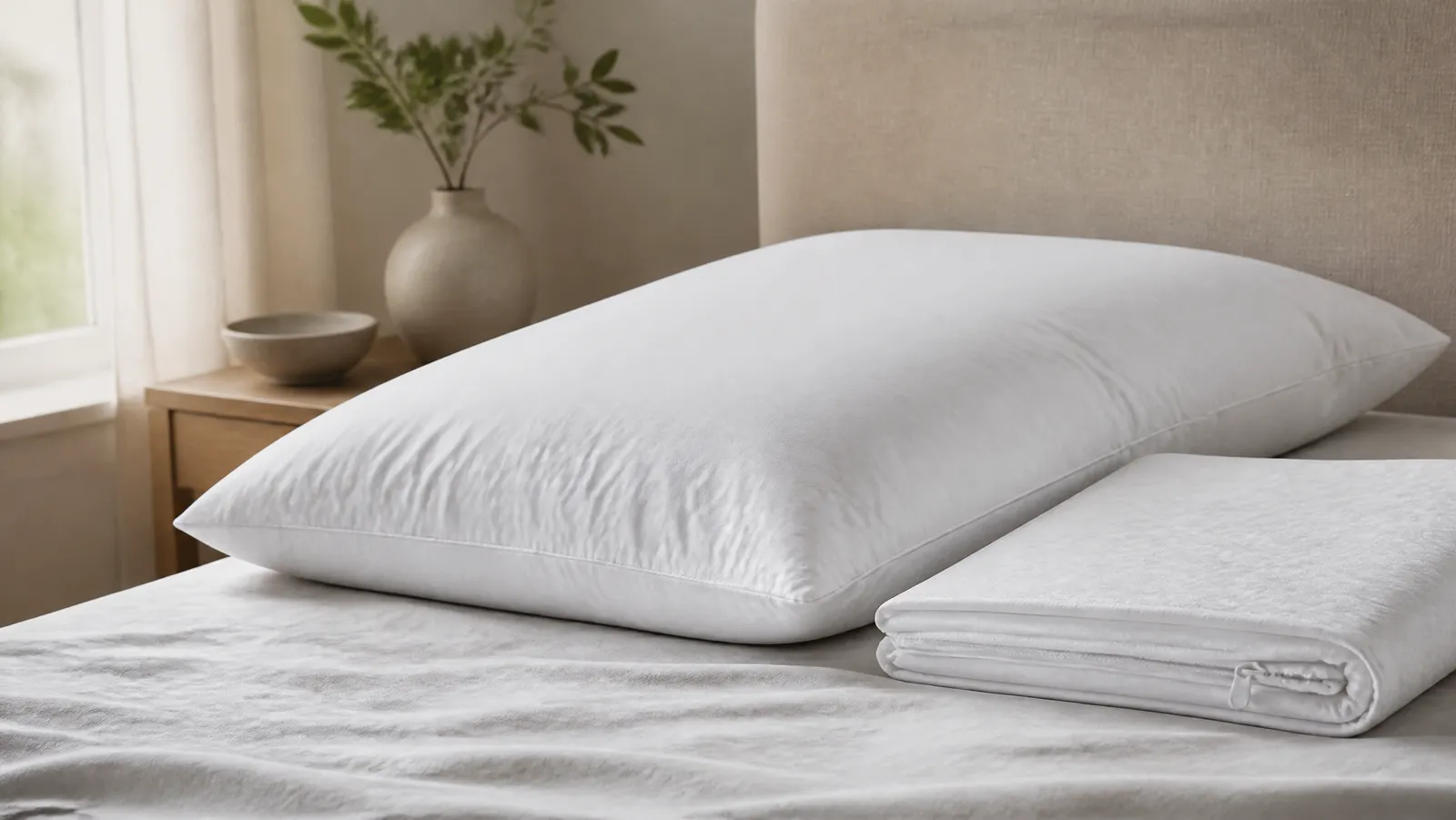
- Put a washable zippered cover on every pillow. It is the layer that can take a weekly hot wash when the pillow cannot; what to look for in the fabric is covered in our guide to dust mite pillow protectors.
- Stop sleeping on wet hair, and air the bed rather than making it the instant you get up.
- Pull the headboard off the cold wall — the practice parameter's advice to move furniture slightly away from walls is aimed at this.
- Mind the humidifier. The AAAAI warns that a humidifier's filter needs regular cleaning and changing so that mold does not grow in the unit and get blown into the home.
And one place nobody looks: the machine. In a study of 70 residential washing machines published in Fungal Biology in 2015, Babič and colleagues found 79% positive for fungi, sampled from the detergent drawer and the rubber door seal, and named detergents and softeners, then washing temperature, as the most important factors for colonisation. A washer that smells is worth cleaning before a pillow goes into it.
The humidity that mites and mold both need
The overlap here is not a metaphor: mites eat fungi. The practice parameter states that "dust mites feed on organic materials, including skin scales, fungi, yeasts, and bacteria", and elsewhere that they feed mainly on organic detritus in house dust, "including desquamated human or pet skin scales, which are colonized by fungi, yeasts, and bacteria".
The shared root cause is humidity. Above 65% relative humidity, according to the same document, the dust and lint in mattresses and pillows absorb enough moisture to support the growth of "some fungi and mites" — one threshold, two organisms. It also reports that the presence of moisture, cockroaches and mold "is associated with increased mite populations", and notes that higher concentrations of dust mite allergen tend to be found in homes with a "musty or mildew odor" and higher bedroom humidity.
So one dehumidifier setting does two jobs: the humidity that mites and mold both need is the thing you are removing. If the mite half is your problem, how to remove dust mites from pillows covers the laundry and encasing side, and dust mites in pillows covers what is living in there.
When to replace the pillow, and what that costs
Five signals that this has stopped being a cleaning question.
- Visible growth in the fill, or on the inside face of the cover.
- A musty smell that survives a wash and a complete dry.
- A soaking not dried within the EPA's 24-to-48-hour window.
- A fill you cannot machine wash — solid memory foam, latex, buckwheat — that got wet.
- Any pillow you cannot get fully dry.
The arithmetic is kinder than people assume. The downluxe pair works out at $14.99 a pillow as of October 2026; the Sasttie firm two-pack at $21.99 as of October 2026 is $11.00 a pillow, the cheapest replacement here. Against rescuing a pillow the EPA's guidance says cannot be reliably cleaned, $11.00 is not a difficult sum. For how long a pillow should last when nothing has gone wrong, see how often to replace your pillow.
The bottom line
Mold in a pillow is a moisture story with a short list of culprits, and incomplete drying after a wash leads it. Fix the water first: find the source, dry anything wet inside 24 to 48 hours as the EPA advises, and get the room under the 60% ceiling all four bodies above share. Then be realistic about the object. A cover is laundry; a pillow with growth through the fill is, per EPA guidance on porous materials, a replacement — and at $11.00 to $14.99 a pillow, that is cheaper than the rescue attempt.
Keep the health claims in proportion. Damp buildings are associated with respiratory symptoms and asthma in the CDC's and WHO's reading of the evidence; "toxic black mold" is not a species, and the CDC says all molds should be handled the same way regardless. If symptoms persist once the pillow and the humidity are sorted, that is a clinician's question. And if you would rather start from a shortlist than a salvage operation, what we look for in a pillow for allergies is the next page.
The shortlist
3 pillows compared — firmness, loft, and temperature side by side. The top pick is highlighted.
| Pillow | Firmness | Loft | Sleeps | Best for | Price |
|---|---|---|---|---|---|
Medium Soft | Medium | Neutral | A washable synthetic pillow you can replace often | $29.98 Check | |
Cheapest Replacement PairSasttie Firm Standard Pillows, Set of 2 | Firm | High | Neutral | Replacing a pillow cheaply when it is past saving | $21.99 Check |
The Part You LaunderAllerEase Premier Zipper Pillow Protector, Standard/Queen, 4 Pack | — | — | Neutral | Getting a zippered cover onto every pillow in the house at once | $21.49 Check |
downluxe Down Alternative Pillows, Standard 20x26, Set of 2
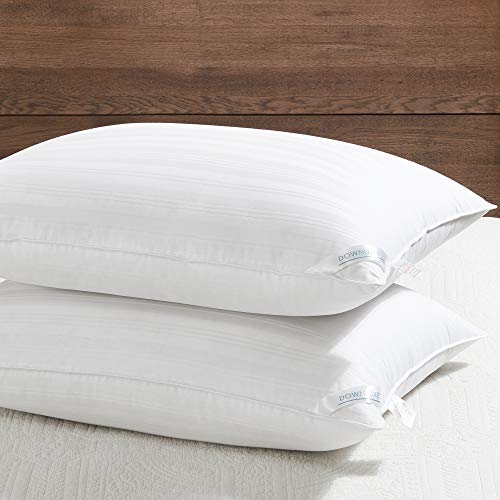
Washable synthetic fill at $14.99 a pillow as of October 2026, and unlike the cheaper Sasttie pair its maker sets no cold-water limit on the wash, which is the difference that matters when the point is washing hot.
The maker names no laboratory and no test of any kind, nothing about it resists fungal growth, and roll-packed pillows need the stated 24 hours to recover their shape before you can judge them.
The EPA's guidance on porous materials is the reason this slot holds a cheap washable pillow instead of a cleaning product: absorbent items that become moldy may have to be thrown away, because the growth is "difficult or impossible to remove completely". So the useful pillow here is one you can wash often and replace without flinching. downluxe states a polyester down-alternative fill, standard 20x26 inches, two per pack, and machine washability — the maker's phrase is "machine washable to easily ensure your pillows are always fresh and clean". At $29.98 as of October 2026 against a $36.99 list price, that is $14.99 a pillow.
Sasttie Firm Standard Pillows, Set of 2

At $11.00 a pillow it is the cheapest replacement pair here, the fill blend is actually disclosed, and OEKO-TEX Standard 100 testing is named.
Firm and high-lofted in a way that will not suit every sleeper, and the maker's cold-wash, tumble-dry-low instruction makes drying a dense fill to the core slower rather than faster.
The arithmetic is the argument. $21.99 as of October 2026 for two pillows is $11.00 a pillow, against $14.99 each for the downluxe pair, and that makes it the cheapest way on this page to act on the honest answer — that a pillow with growth through the fill gets replaced rather than cleaned. Sasttie describes the fill in its own words as 40% 3D fibre and 60% 7D fibre, states testing to OEKO-TEX Standard 100, and says to machine wash cold and tumble dry on low. Low is the catch: a cool dryer is exactly where a thick synthetic core stays damp.
AllerEase Premier Zipper Pillow Protector, Standard/Queen, 4 Pack

A zippered cover the maker says can be washed hot, at $5.37 each, which puts a launderable layer on every pillow in the house for the price of one pillow.
Wash hot but dry on the lowest setting is genuinely easy to get backwards, and there is no named test, no pore-size figure and no anti-fungal claim behind the fabric.
A cover is the opposite of a pillow in this argument: thin, launderable, and cheap enough to replace, so it is the layer that takes the weekly wash while the pillow underneath stays dry. Aller-Ease says to machine wash hot with non-chlorine bleach when needed, then tumble dry on the lowest setting, and not to iron. Four covers at $21.49 as of October 2026, down from a $27.99 list price, is $5.37 each — every pillow in the house in one load. Read it as a barrier and laundry product only: the maker names no pore size, no third-party test and no anti-fungal property.
You Think a Pillow Has Mold: What to Do, in Order
This is a moisture problem with a cleaning problem attached, and the order matters — the last two steps are the ones that stop it happening again.
Mold in Pillows FAQ
Can mold really grow in a pillow? Yes, given water. The EPA's mold course states that "to grow indoors, mold needs moisture and food", that "mold can grow on virtually any organic substance" including paper, cloth, wood and soil, and that it is impossible to get rid of all mold and mold spores indoors. Spores are already in the room; a wet pillow is what turns them into growth.
What causes mold in pillows most often? Incomplete drying after a wash is the cause we would warn about first, because a pillow can feel dry on the outside while the core is still wet. The Sleep Foundation's washing guidance makes the same point about drying the interior fill even when the cover feels dry. After that: night sweats and damp hair, condensation on a cold exterior wall behind the bed, a chronically damp room, and storage in a damp loft or basement.
Can you wash mold out of a pillow? Usually not, and this is the most useful answer on the page. The EPA states that absorbent or porous materials, such as ceiling tiles and carpet, "may have to be thrown away if they become moldy" because mold "may be difficult or impossible to remove completely" once it is into the crevices of a porous material. We found no published laundering test for pillows specifically that we would repeat, and any wash temperature quoted confidently as mold-killing for a pillow core deserves suspicion.
Can a moldy pillow make you sick? The honest answer is that the evidence is about damp buildings, not pillows. The CDC states that "exposure to damp and moldy environments may cause a variety of health effects, or none at all", that mold can cause "a stuffy nose, sore throat, coughing or wheezing, burning eyes, or skin rash" in some people, and that people with asthma or mold allergy may have severe reactions while immune-compromised people and people with chronic lung disease may get lung infections. Nobody has measured a pillow as an exposure on its own.
What are the symptoms of mold exposure at home? The CDC cites a 2004 Institute of Medicine finding of "sufficient evidence to link indoor exposure to mold with upper respiratory tract symptoms". The World Health Organization's 2009 indoor air quality guidelines on dampness and fungal growth reported that occupants of damp or moldy buildings have up to a 75% greater risk of respiratory symptoms and asthma, that children are particularly susceptible, and that 13% of childhood asthma in developed countries in the WHO European Region could be attributable to damp housing. None of that tells you why you woke up congested, which is a question for a clinician.
Is black mold on a pillow more dangerous? Colour is not a species. The EPA's mold course states that "'Black mold' is not a species or specific kind of mold, and neither is 'toxic mold.'" It adds that some but not all molds "may produce potentially toxic byproducts called mycotoxins under some conditions" and that "no one can tell whether a mold is producing mycotoxins just by looking at it". The CDC says a possible association between acute idiopathic pulmonary hemorrhage among infants and Stachybotrys chartarum "has not been proven" and that further studies are needed.
Can memory foam, latex or buckwheat pillows get mold? They can get wet, which is the problem, and they are the fills you cannot put through a machine. The Sleep Foundation states that "solid memory foam pillows should not be machine washed, as this can cause the foam to crack or degrade" and should not be submerged in water, recommending spot cleaning instead. Makers of latex and buckwheat pillows generally give the same instruction — wash the cover, keep the fill dry — and we could not find guideline-level guidance for either, so your own care label is the authority.
Does a pillow protector stop mold? No cover we have seen makes a tested anti-fungal claim, and we would not believe one that did. What a zippered protector does is give you a layer you can actually launder weekly, which is the realistic prevention step for a pillow you cannot wash often. Treat it as laundry, not armour.
Why you can trust us

Aimee Cannon
Sleep & bedding writer
Aimee Cannon is a sleep and bedding writer who has spent years testing pillows of every kind — memory foam, down, wool, bamboo, buckwheat, and specialty support pillows. She focuses on matching the right pillow to each sleeping position and need, and reports what actually holds up after months of nightly use. When she is not testing pillows, Aimee is usually with her husband and her dog.