Are Memory Foam Pillows Good for Allergies?
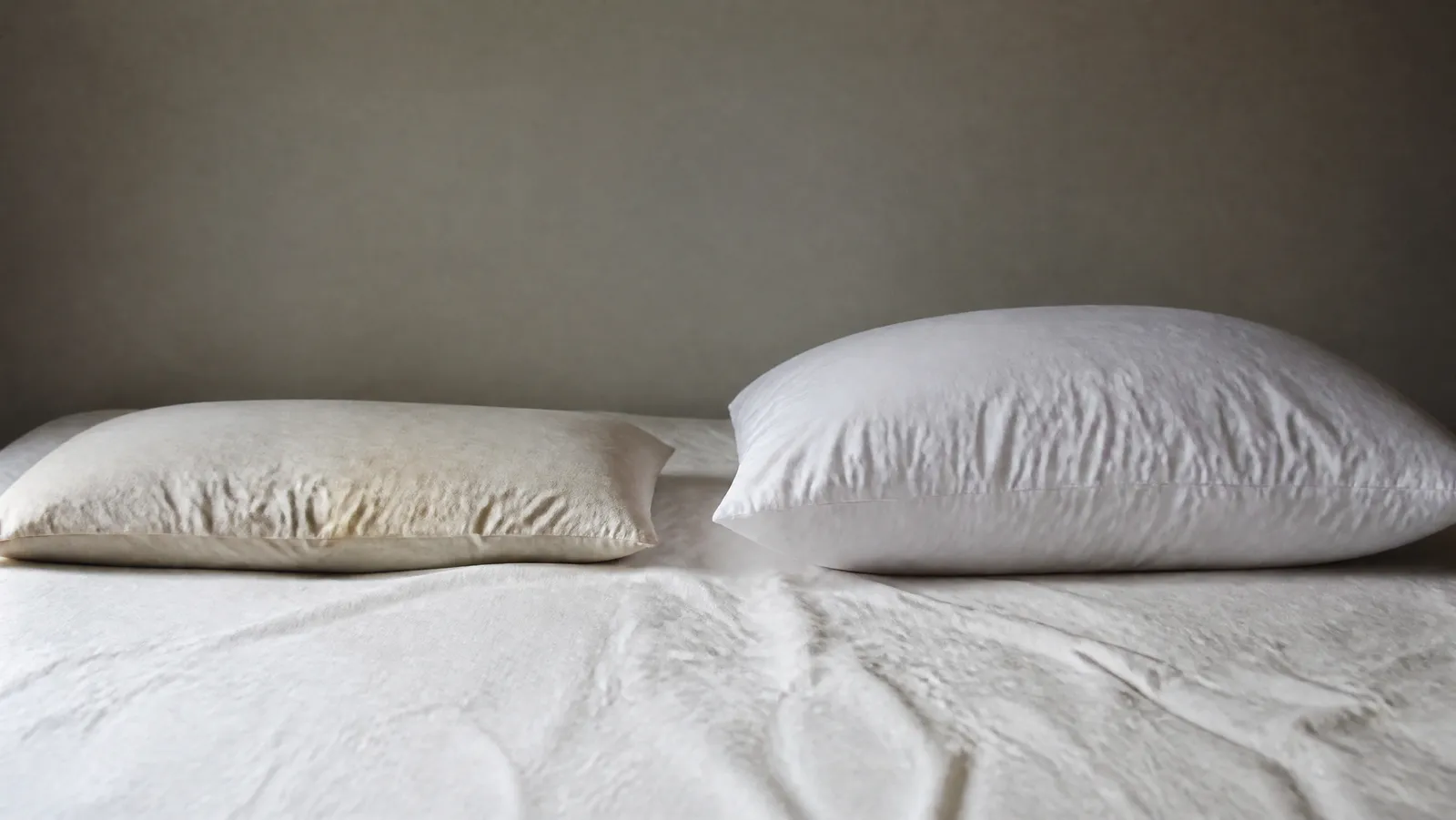
Are memory foam pillows good for allergies? Not in the way the packaging implies — the fill inside a pillow is not the lever. The 2013 AAAAI/ACAAI dust mite practice parameter puts it flatly: "Foam pillows are not less prone to dust mite allergens than are feather pillows." What changes your exposure is the cover over the pillow, the wash routine around it, and the humidity in the room. We may earn a commission from links on this page, at no extra cost to you.
That is the deflating half of the answer. The useful half is that three differences between a memory foam pillow and a fibre one are genuinely real — and only one of them goes the way the marketing suggests. If you would rather start from a shortlist than an argument, the pillows we recommend for allergies ranks the interventions before the products.
Are memory foam pillows good for allergies? What the guidelines actually say
Two sentences from one document do most of the work here, and almost nobody selling pillows quotes them.
The document is Environmental Assessment and Exposure Control of Dust Mites: a Practice Parameter, published by Portnoy and colleagues in Annals of Allergy, Asthma and Immunology in 2013 and accepted jointly by the AAAAI and the ACAAI. On bedding it states: "Nonallergenic pillows are not a substitute for covering them with allergy-proof encasements." And, separately: "Foam pillows are not less prone to dust mite allergens than are feather pillows."
Read those carefully. Neither says foam is bad. Both say the pillow is the wrong object to be shopping for.
The parameter's graded advice puts the barrier first instead. Summary statement 17 is to "Recommend that patients should use mite allergen–proof mattress, box spring, and pillow encasings to decrease exposure to mite allergens" — strong recommendation, B-level evidence. Summary statement 13 advises that "bedding should be washed weekly to decrease dust mite numbers and mite allergen levels" — also strong, also B. Nowhere in that hierarchy does the fill appear as a measure in its own right.
Are memory foam pillows hypoallergenic? The label is not a test
Short answer: the word is unregulated, so a foam pillow marked hypoallergenic has made a statement rather than passed anything.
According to the US Food and Drug Administration, "there are no Federal standards or definitions that govern the use of the term 'hypoallergenic'," the term "means whatever a particular company wants it to mean," and manufacturers "are not required to submit substantiation of their hypoallergenicity claims to FDA." FDA issued a regulation in 1975 that would have required comparative testing; cosmetics makers challenged it and the appeals court held the regulation invalid. That statement is about cosmetics, and we could find no federal standard defining the word for a textile either.
The one programme here that is a test rather than a word is the asthma & allergy friendly Certification Program, run by the Asthma and Allergy Foundation of America with Allergy Standards Limited, which in its own words tests household products "against strict standards" and awards a mark to those that pass. Look for that; ignore the adjective. We take the whole question apart in what "hypoallergenic" actually means.
What the label usually means in practice is "nothing was measured." The JOLLYVOGUE cooling down-alternative pillows, $20.99 for a pair as of October 2026, are here as a teaching example rather than a recommendation: the listing names an OEKO-TEX Standard certified factory and makes no allergen claim at all. That absence is more honest than most foam listings, and it is what you are buying when a pillow says hypoallergenic — a fill type, not a result.
The research you have half-heard: synthetic fill held more allergen, not less
In October 1996 the BMJ published a short letter from T J Kemp, R W Siebers and colleagues at the Wellington Asthma Research Group, "House dust mite allergen in pillows". As later papers in the field describe that letter, it reported mite allergen in nine pairs of pillows — each pair one feather-filled and one polyester-filled, used together on the same bed for more than six months — and the polyester pillows carried substantially more Der p 1, the major mite allergen, than the feather ones.
We will not quote you a ratio. We could not read the full letter, and the secondary summaries of it give different multiples; a number that changes depending on who is repeating it is not a number.
The direction of the finding is much better attested than any single figure. The Cochrane review Feather versus non-feather bedding for asthma, by Campbell and Gibson, reports that synthetic pillows "appear to accumulate dust mite allergen more rapidly than feather pillows" and "have also been found to contain significantly higher levels of mite allergen than feather pillows."
Three caveats, all load-bearing. The fill in that work was polyester fibre, not memory foam. Nine pairs is a small sample. And the same Cochrane review "found no trials comparing feathers with man-made fibres," concluding that "research is needed to be certain which is better for people with asthma" — so this is a finding about measured allergen, not about how anyone slept.
What we could not find is any published measurement of mite allergen in memory foam pillows specifically. Articles that tell you dense foam gives mites nothing to burrow into are reasoning from the material's structure, not reporting a result, and the practice parameter's flat sentence about foam is the closest thing to an authoritative verdict anyone has.
Why the ticking, not the fill, explains the difference
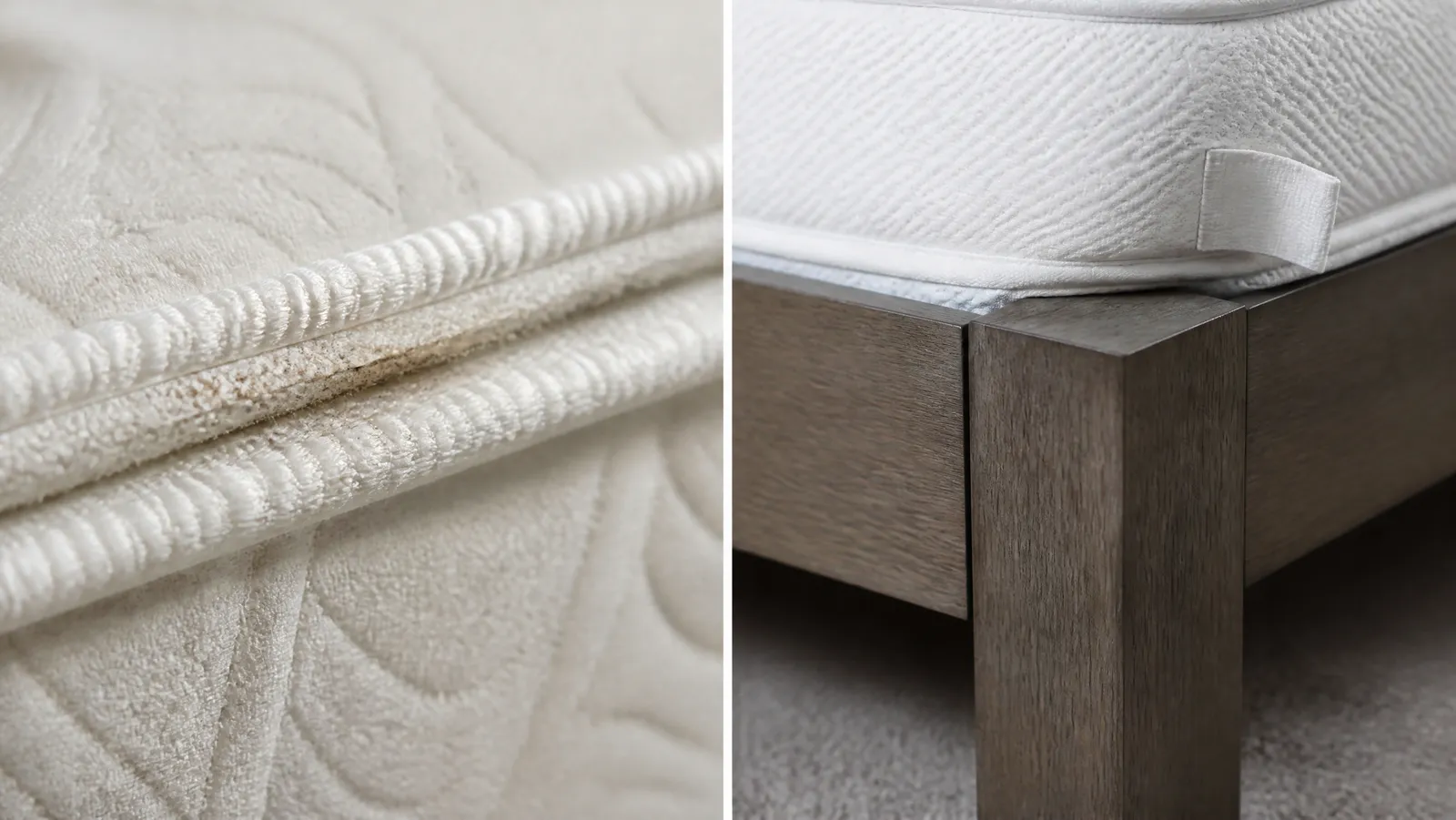
Cochrane offers an explanation that moves the whole argument off the fill: "One explanation for this difference is that feathers are contained within more tightly woven fabrics than synthetic fillings," and that "close weave may therefore act as a barrier to dust mites and their allergens."
If that is right, the shell has been doing the work all along — and the shell is the one part of a pillow you can upgrade. A cover you choose can be tighter than any factory ticking.
The practice parameter is specific about what tight means. It states that "Woven microfiber fabrics with a mean pore size smaller than 10 µ can effectively block passage of Der p 1," and that "Nonwoven encasings are not recommended because they trap mite allergens" and are not washable, so allergen collects on the surface the sleeper lies on. Woven, not nonwoven: that is the buying rule, and it says nothing about what is inside.
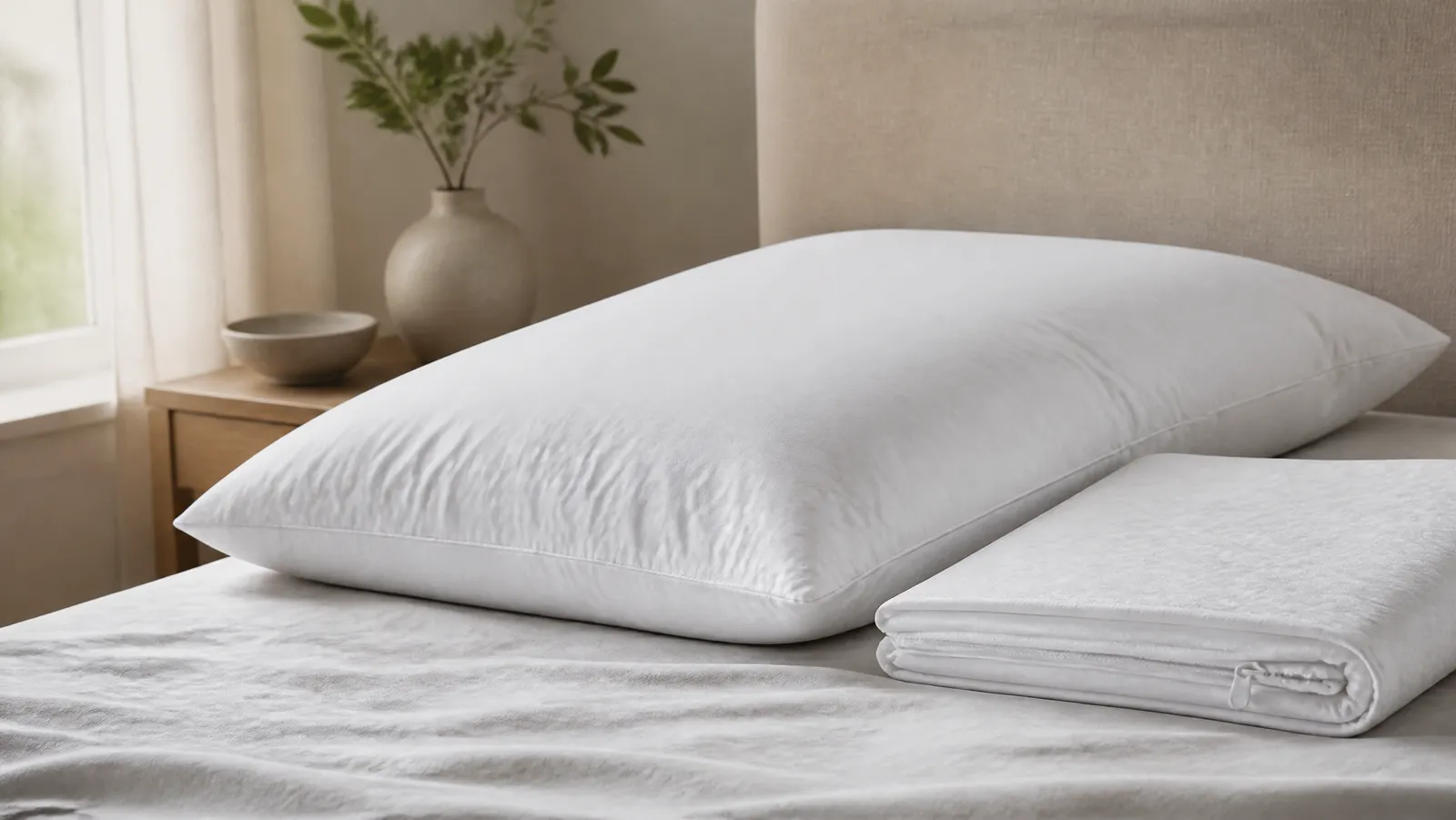
Our pick is the Mission: Allergy Barrier II pillow encasing at $24.95 as of October 2026 — a woven microfibre cover, and the only one we have reviewed that names a third-party laboratory. Mission: Allergy states it is medical grade, blocks 100% of dust mite and animal dander allergens, and was third-party tested by Indoor Biotechnologies, Inc. It will go over the foam pillow you already own, which is the point. The listing publishes no mean pore size, so we report the named test rather than the number.
This is also why the feather-versus-foam framing readers arrive with tends to collapse on contact with the evidence — we take the other side of it in whether down pillows are bad for allergies.
Do memory foam pillows cause allergies? Not directly, but they cannot join the wash
Here is the one honest functional difference, and it is the most practical thing on this page: a solid memory foam pillow cannot be machine washed, so it cannot take part in the step the guidelines grade most highly after encasing.
Summary statement 13 of the practice parameter advises that bedding "should be washed weekly to decrease dust mite numbers and mite allergen levels" — strong recommendation, B-level evidence. Weekly.
Now the care labels. Tempur states that "The TEMPUR Material cannot be washed or dry cleaned," and tells owners instead to "remove the cover and ventilate the TEMPUR material, or wipe off carefully using a well-wrung cloth." Sleep Foundation's general guidance agrees and explains the mechanism: "You shouldn't wash most memory foam pillows in a washing machine or dry them in a dryer," because the foam "can break down if exposed to excessive agitation or moisture, both of which it would experience in a washer," and "Heat from a dryer can also damage the material." Its suggested cleaning interval for a pillow is "at least twice a year."
Twice a year against weekly. That gap is not an allergy claim about foam; it is a structural fact about what a foam pillow can do. The only washable component is the cover, so the cover does double duty — barrier and laundry.
A shredded fill or a fibre fill can simply go in the machine. Sleep Foundation notes shredded memory foam as the exception to its own rule, and only where the maker recommends a gentle cycle. For a fibre pillow, the downluxe down-alternative pair at $29.98 as of October 2026, down from a $36.99 list price, states the case plainly: the maker describes them as "machine washable to easily ensure your pillows are always fresh and clean." That is a washability claim, not an allergy claim, and we are presenting it as exactly that. The routine the wash belongs to is in how to prevent a dust mite allergy flare-up.
Heat and moisture: a mechanism worth knowing, not a measurement
Dust mites are water managers before they are anything else. The practice parameter states that "Mites require RH higher than 65% to prevent water loss and to thrive," and that "Once humidity decreases below 50%, mite proliferation decreases and survival is decreased." Summary statement 10 turns that into graded advice: "relative humidity in the home should be kept at 35% to 50% to decrease the growth of dust mites" — strong recommendation, B-level evidence.
Foam's reputation for sleeping warm is therefore at least relevant. Sleep Foundation describes memory foam as "notorious for trapping heat." Tempur's own care guidance asks owners to ventilate the material "to remove any moisture" and to store products in a dry environment at "maximum 65% relative humidity" — a figure that lands oddly close to the mite threshold, although Tempur is talking about protecting foam rather than about mites.
We are going to stop short of the obvious conclusion, because nobody has measured it. We found no study comparing mite or mould populations inside memory foam pillows against other fills. The mechanism is plausible and the numbers either side of it are real; the link between them is not evidence.
Can you be allergic to memory foam itself?
The honest version of this answer is a distinction rather than a verdict.
An allergy is an immune response to a specific protein. The smell of a new foam pillow is a different phenomenon. According to the EPA, the health effects of exposure to volatile organic compounds "may include" "Eye, nose and throat irritation" and "Headaches, loss of coordination and nausea"; the agency lists "building materials and furnishings" among VOC sources, advises increasing ventilation, and notes that "elevated concentrations can persist in the air long after the activity is completed." Tempur tells new owners to "ventilate the product well before use" to reduce the initial smell.
That is an irritant story rather than an immune one, and the practical response differs: airing a new pillow out addresses the first and will do nothing for the second. There is more on how long that takes in how long a new pillow's smell lasts. We found no body of published evidence establishing cured polyurethane foam as a common allergen, and we are not going to manufacture one in either direction.
One fill in this conversation does carry a well-documented allergy, and it is not polyurethane. If you are moving off foam towards a washable latex pillow, read this first. The American College of Allergy, Asthma and Immunology says natural rubber latex "comes from the sap of the rubber tree, Hevea brasiliensis," and "should not be confused with synthetic rubber made from chemicals." Its listed symptoms "may include hives, itching, stuffy or runny nose"; it "can cause asthma symptoms of wheezing, chest tightness and difficulty breathing"; and "The most severe latex allergy can result in anaphylaxis." ACAAI names people who frequently wear latex gloves, people who have had multiple surgeries, and people with other allergies among those at higher risk. If any of that describes you, that swap is a question for a clinician first.
This is not the same question as whether memory foam is toxic
These two searches land on the same shelf and they are not the same subject. Allergy is about proteins — mite faecal allergen, pet dander, latex. Toxicity is about chemistry — emissions, residues, flame retardants, what is in the foam rather than what grows on it. Different evidence, different page: whether memory foam pillows are toxic handles the chemistry, and nothing here should be read as an answer to it.
Memory foam pillow allergy symptoms: what they usually turn out to be
Waking congested, sneezing or with itchy eyes on a memory foam pillow is a real experience, and a pillow review cannot tell you which cause is yours. The plausible ones point in different directions:
- Mite allergen already in the bed, which a new pillow does not remove and which the encasement and the weekly wash are the graded measures against.
- Irritation from the VOCs of a new foam product, which the EPA's list of possible effects covers and which airing the pillow out may reduce.
- Something else in the bedroom — pet dander, pollen, visible mould — none of which the pillow is responsible for.
- A reaction to a cover fabric or finish rather than to the foam core underneath it.
Allergy and asthma are medical conditions. If symptoms are regular, a clinician who can test you is a better next step than another pillow, and nothing on this page is a substitute for treatment you have been prescribed.
The bottom line
Foam is neither the villain nor the fix. The practice parameter says foam pillows are no less prone to mite allergen than feather ones, and that a nonallergenic pillow is not a substitute for an encasement. The research most readers half-remember found more allergen in synthetic fill, not less, and the best available explanation for it is the tightness of the fabric rather than the stuffing. "Hypoallergenic" is not a tested property. The single real strike against memory foam is that you cannot wash it, which keeps it out of a strongly graded weekly step.
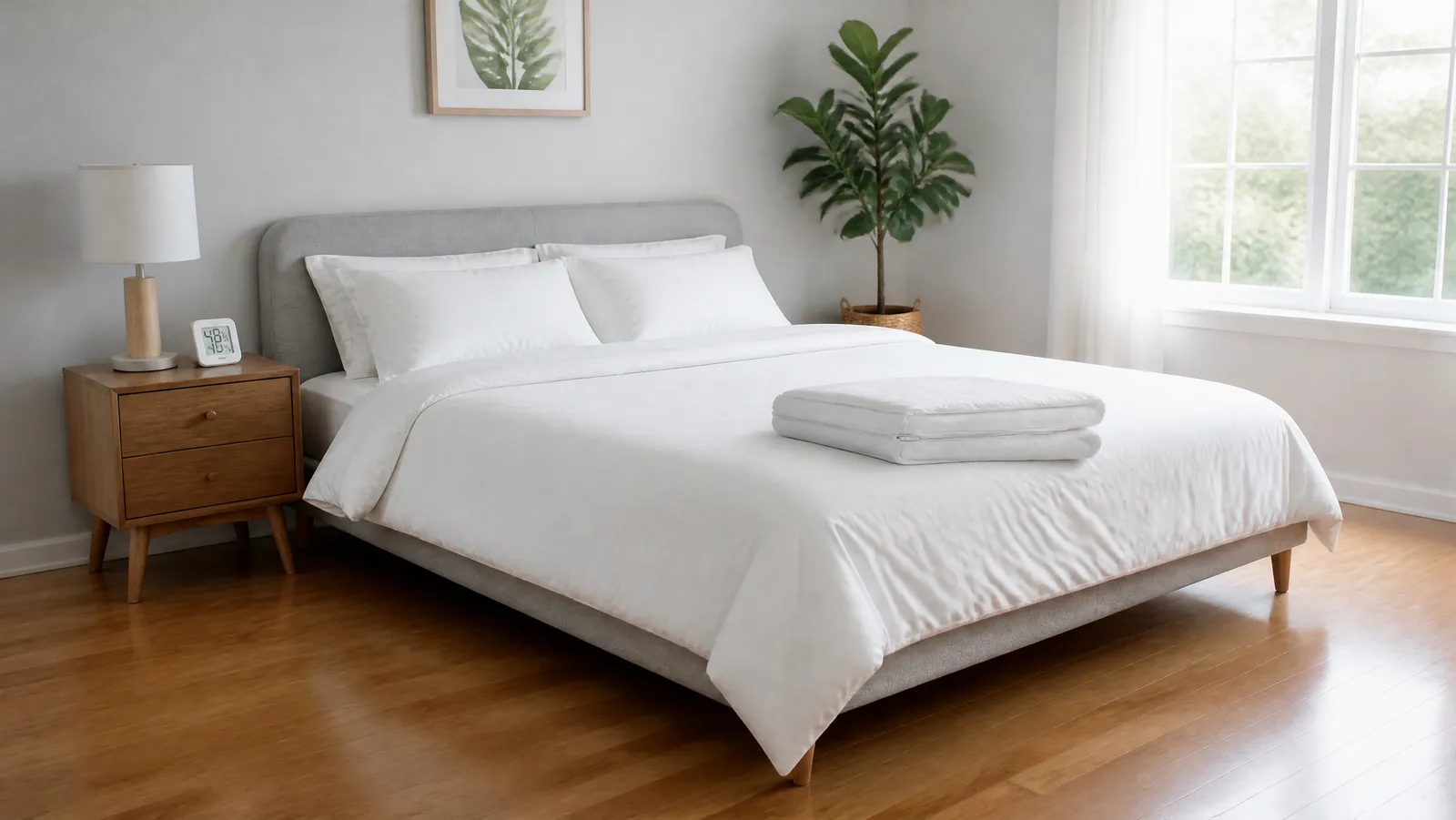
So: if you own a foam pillow you like, encase it in a woven cover, wash that cover with the sheets, and keep the room between 35% and 50% relative humidity. If you are buying for allergies, buy the barrier first and then choose a fill you can put through the machine. That logic applied to a shortlist rather than a set of quotations is in the Home Pillow Review allergy pillow guide — and if you are reading this at 3am because you wake up blocked every morning, the appointment is worth more than the pillow.
The shortlist
3 pillows compared — firmness, loft, and temperature side by side. The top pick is highlighted.
| Pillow | Firmness | Loft | Sleeps | Best for | Price |
|---|---|---|---|---|---|
| — | — | Neutral | Putting a tightly woven encasing on the pillow you already own | $24.95 Check | |
A Washable Pillow Pairdownluxe Down Alternative Pillows, Standard 20x26, Set of 2 | Medium Soft | Medium | Neutral | A washable synthetic pillow you can replace often | $29.98 Check |
No Allergen Claim At AllJOLLYVOGUE Cooling Down Alternative Pillows, Standard, Set of 2 | — | High | Cooling | Showing what a pillow listing says when it makes no allergen claim | $20.99 Check |
Mission: Allergy Dust Mite and Allergen Proof Pillow Encasing (Cover); Barrier II (Standard Size)
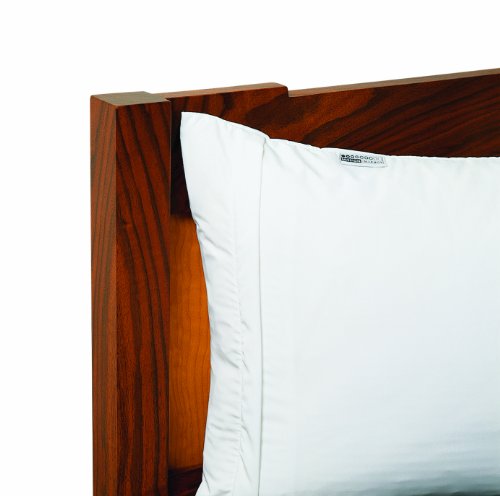
It is woven rather than nonwoven, it names a third-party testing laboratory rather than just a claim, and the maker states bound seams, interior and exterior zipper flaps and a ten-year warranty.
The 100% blocking figure is the manufacturer's own commissioned result and the listing publishes no mean pore size, which is the number the practice parameter actually specifies.
If the fill is not the lever and the cover is, this is the conclusion of the article in product form — and it works on a memory foam pillow you have no intention of replacing. The practice parameter endorses woven microfibre encasings and recommends against nonwoven ones; this is the woven kind. Mission: Allergy states it is medical grade, blocks 100% of dust mite and animal dander allergens, and was third-party tested by Indoor Biotechnologies, Inc. — the only named lab we have seen on a cover listing. At $24.95 as of October 2026 it fits the foam pillow you already own, so nothing has to be thrown away to use it.
downluxe Down Alternative Pillows, Standard 20x26, Set of 2
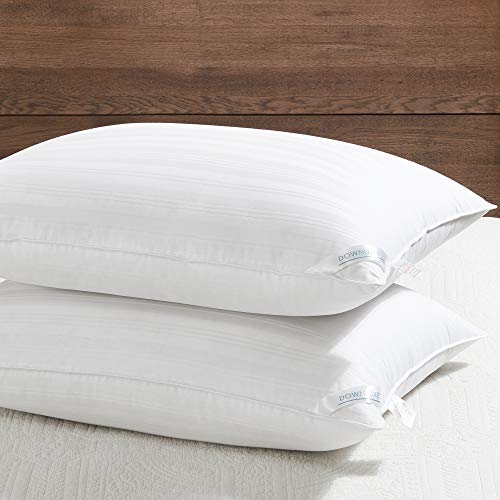
The maker states the pillows are machine washable, which is what lets a pillow take part in the weekly bedding wash instead of quietly opting out of it, and a pair at this price is cheap to replace.
It carries no allergen test, no named laboratory and no barrier claim, it only comes as a two-pack, and the maker asks for 24 hours after unpacking before the shape recovers.
This pillow is here on washability, not on allergy performance, and the distinction is the whole point. The practice parameter grades weekly washing of bedding a strong recommendation on B-level evidence, and a solid memory foam core cannot join that routine — Tempur states its material "cannot be washed or dry cleaned." downluxe states the opposite of its polyester down-alternative fill: "machine washable to easily ensure your pillows are always fresh and clean." Two standard pillows at $29.98 as of October 2026, against a $36.99 list price, buys a fill you can put through the wash and replace often.
JOLLYVOGUE Cooling Down Alternative Pillows, Standard, Set of 2

It is machine washable, the maker names an OEKO-TEX Standard certified factory rather than inventing an allergy claim, and a pair costs less than one encasing.
There is no allergen claim, no named test and no barrier figure anywhere on the listing, and the maker markets it as both cooling and firm while also saying it suits people who prefer soft, which makes the firmness marketing meaningless.
A teaching example rather than an allergy pick, and we would rather say so than dress it up. The listing for this micro polyester fibre down-alternative pair makes no allergen claim at all and names no allergen test. What it does name is an OEKO-TEX Standard certified factory, a maker claim about substances rather than about barriers. That absence is the useful part: it is what sits behind most pillows sold as hypoallergenic, foam included. At $20.99 as of October 2026 against a $24.99 list price, it is a cheap washable pillow, which is a real thing to be.
What to Do With the Memory Foam Pillow You Already Own
Nothing below asks you to throw the pillow out. The 2013 AAAAI/ACAAI dust mite practice parameter does not support that, and this is the order its own grades suggest.
Memory Foam and Allergies FAQ
Are memory foam pillows hypoallergenic? Not in any tested sense. The US Food and Drug Administration states that "there are no Federal standards or definitions that govern the use of the term 'hypoallergenic'," that the term "means whatever a particular company wants it to mean," and that manufacturers "are not required to submit substantiation of their hypoallergenicity claims to FDA." FDA's 1975 regulation requiring comparative tests was challenged by cosmetics makers and held invalid on appeal. That statement is about cosmetics, and we could find no federal standard defining the word for a textile either.
Do memory foam pillows attract dust mites? The practice parameter's position is that foam is not an exception: "Foam pillows are not less prone to dust mite allergens than are feather pillows." We found no published measurement of mite allergen in memory foam pillows specifically, so anyone telling you dense foam resists mites is reasoning from the material rather than reporting a result.
Is it true that synthetic pillows had more mite allergen than feather ones? That is the direction of the research, yes. The Cochrane review Feather versus non-feather bedding for asthma reports that synthetic pillows "appear to accumulate dust mite allergen more rapidly than feather pillows" and "have also been found to contain significantly higher levels of mite allergen than feather pillows." Its proposed explanation is the fabric, not the fill: "One explanation for this difference is that feathers are contained within more tightly woven fabrics than synthetic fillings." The same review "found no trials comparing feathers with man-made fibres."
Can you be allergic to memory foam? We found no body of published evidence establishing that cured polyurethane foam is a common allergen, and we would not assert one either way. What is better documented is irritation from the smell of a new foam product. The EPA's list of possible VOC health effects includes "Eye, nose and throat irritation" and "Headaches, loss of coordination and nausea." That is an irritant response rather than an immune one, and it is a different thing from an allergy even when it feels similar at 3am.
What about latex instead? Latex is the one fill in this conversation with a well-documented allergy attached. The American College of Allergy, Asthma and Immunology says natural rubber latex "comes from the sap of the rubber tree, Hevea brasiliensis," that symptoms "may include hives, itching, stuffy or runny nose," that it "can cause asthma symptoms of wheezing, chest tightness and difficulty breathing," and that "The most severe latex allergy can result in anaphylaxis." It lists health care workers who frequently wear latex gloves, people who have had multiple surgeries, people often exposed to natural rubber latex, and people with other allergies among those at higher risk. Raise it with a clinician before you buy, not after.
Can I wash a memory foam pillow to deal with allergens? No, and that is the single most practical finding on this page. Tempur states that "The TEMPUR Material cannot be washed or dry cleaned." Sleep Foundation says most memory foam pillows should not go in a washer or dryer because the foam "can break down if exposed to excessive agitation or moisture, both of which it would experience in a washer," and that "Heat from a dryer can also damage the material." It recommends cleaning a pillow "at least twice a year." Shredded foam is the exception, and only where the maker recommends a gentle cycle.
Does a memory foam pillow sleep too warm to be a good idea for allergies? It may sleep warm — Sleep Foundation describes memory foam as "notorious for trapping heat" — and warmth with trapped moisture is the condition mites and fungi prefer. But we found no study measuring mite or mould populations inside memory foam pillows against other fills, so treat this as a mechanism worth knowing rather than a measured finding.
Is this the same question as whether memory foam is toxic? No. Allergy is about proteins such as mite faecal allergen and pet dander. Toxicity is about chemistry — emissions, residues, flame retardants. Different evidence, different page.
Why you can trust us

Aimee Cannon
Sleep & bedding writer
Aimee Cannon is a sleep and bedding writer who has spent years testing pillows of every kind — memory foam, down, wool, bamboo, buckwheat, and specialty support pillows. She focuses on matching the right pillow to each sleeping position and need, and reports what actually holds up after months of nightly use. When she is not testing pillows, Aimee is usually with her husband and her dog.