The Best Non-Toxic Pillows (2026 Review)
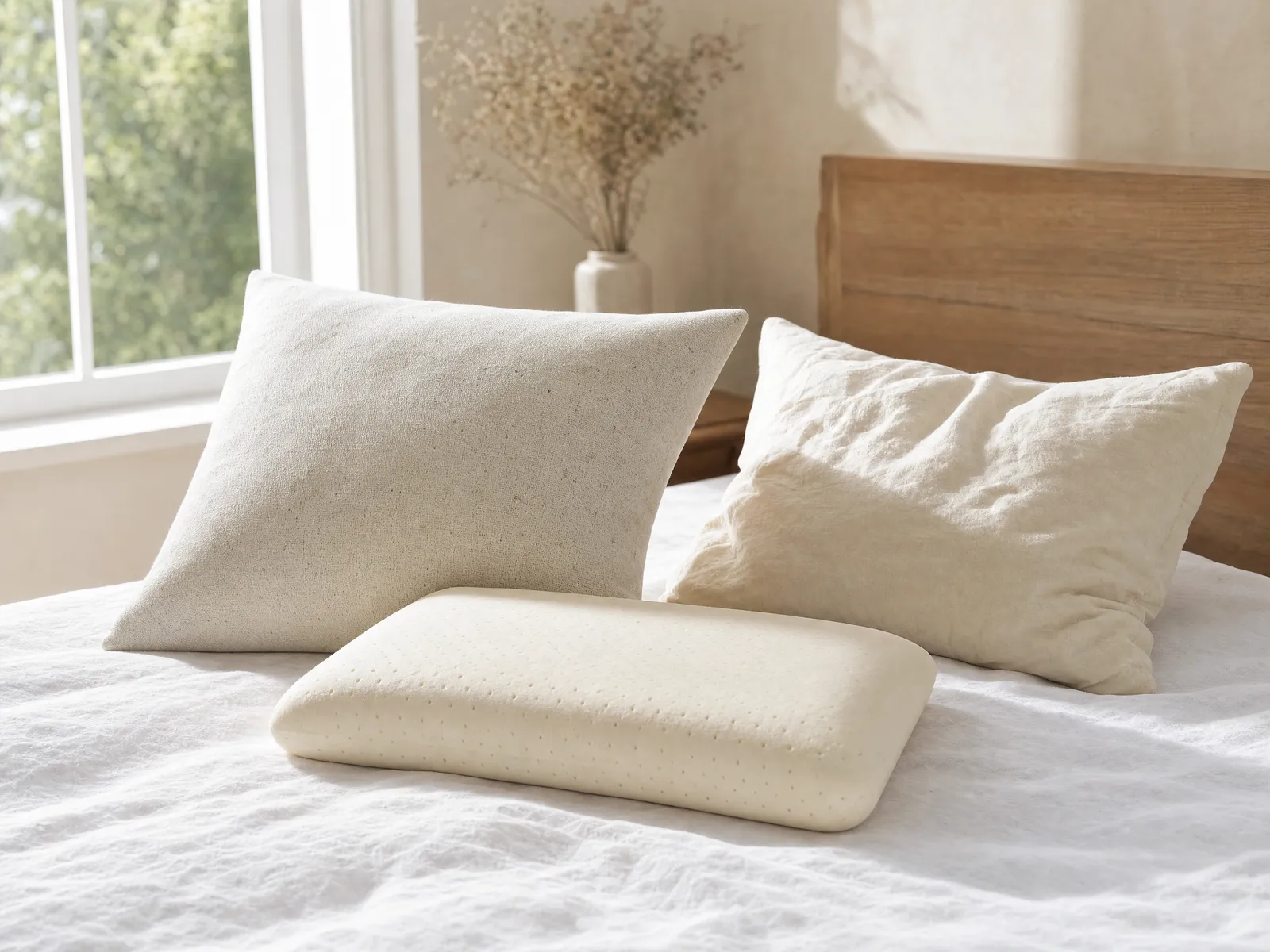
The best non-toxic pillows are the ones whose materials you can name and whose chemistry a named third party has actually tested — OEKO-TEX Standard 100 on the textile side, CertiPUR-US or GREENGUARD Gold on foam. "Non-toxic" itself has no legal definition, and no pillow is "chemical-free", because everything is made of chemicals. What you can buy is known materials with verifiable testing behind them. We may earn a commission from links on this page, at no extra cost to you.
Our pick for most people is the LOFE Organic Pillow at $39.95 as of August 2026, and its name oversells what is inside: LOFE says the cover and inner shell are 100% organic cotton, but the fill is polyester pearl fibre. It takes the top slot on outside testing, adjustability and price, not on being all-natural. If a natural fill is your point, skip ahead to the latex, kapok, wool and buckwheat picks.
What a non-toxic pillow actually is
Three things on a pillow listing are checkable. Everything else is atmosphere.
- What it is made of. Fill and shell are separate materials with separate chemistry, and a listing that names only one has told you half the story.
- What a named third party tested it against. OEKO-TEX STANDARD 100, GOTS, CertiPUR-US and GREENGUARD Gold are real programs with published criteria and searchable certificate databases.
- What that testing does not cover. The part marketing never volunteers, and the part we spend most of this guide on.
The framing worth holding onto: hazard is not the same as risk. A chemical class can have documented hazardous properties in occupational or animal studies without a specific pillow delivering any meaningful dose to a sleeper. Most writing in this category slides from the first to the second in one sentence. We will try not to — which means you will read "we do not know" more than once, and that we will not call any specific product non-toxic or safe. What we can tell you is what a pillow is made of, who tested it, against what list, and where the evidence runs out.
That same method applied to the most common fill on the market is our guide to whether polyester pillows are toxic.
PFAS: the chemistry buyers are actually worried about
Per- and polyfluoroalkyl substances are why most people end up on a page like this. According to the US Environmental Protection Agency, people are exposed through drinking water, certain foods including fish, swallowing contaminated soil or dust, breathing contaminated air, and using products made with PFAS or packaged in materials containing them. EPA says current peer-reviewed studies suggest exposure to certain PFAS may be linked to a range of health effects, including reproductive and developmental effects, increased risk of some cancers and reduced immune response — while cautioning that there are thousands of PFAS with varying toxicity and that most studies cover only a limited number of better-known compounds.
Here is the part that matters for bedding, and it is more reassuring than the category's marketing suggests. In textiles, fluorinated chemistry has mostly been used to make things stain-, water- or wrinkle-resistant — a description of mattress protectors, waterproof pads and treated comforters, not of a bare pillow insert. When Toxic-Free Future lab-tested 20 bedding products for a report published in 2022, it reported PFAS in 9 of the 13 items marketed as stain- or water-resistant, including all four comforters. Its sample covered comforters, mattress pads and covers, and sheets and pillowcases — not pillow inserts.
Regulation is moving, but state by state rather than nationally, and the dates matter. Since 1 January 2025, California's AB 1817 has barred the sale of textile articles containing regulated PFAS at or above 100 ppm measured as total organic fluorine, and its definition of covered textiles names bedding explicitly; that threshold drops to 50 ppm on 1 January 2027. Minnesota's Amara's Law, codified at Minn. Stat. 116.943, has prohibited intentionally added PFAS in eleven product categories since the same date, and its definition of "textile furnishings" also names bedding. There is no equivalent nationwide US ban, so where you live changes the answer.
So the honest answer on whether pillows contain PFAS is that it depends almost entirely on what was applied to the shell, and that published testing of bare pillows is thin. To lower your odds, the practical move is not hunting for a "PFAS-free" label — it is avoiding pillows and pillow protectors sold on stain resistance, waterproofing or "easy clean" finishes.
OEKO-TEX, GOTS, CertiPUR-US: what the labels mean
Four marks do most of the work in this category, and each covers a different thing.
- OEKO-TEX STANDARD 100 tests every component of a textile product — threads, buttons, accessories, not just the main fabric — against a list of over 1,000 substances. OEKO-TEX bans the intentional use of PFAS across its certifications and, per its partner institute Hohenstein, requires certified products to meet a limit of 25 ppb for each regulated PFAS substance as of 1 January 2026, with the total fluorine limit dropping from 100 ppm to 50 ppm during 2026. It says nothing about whether a fibre is organic.
- GOTS, the Global Organic Textile Standard, is the organic-fibre standard. Its "organic" grade requires a minimum of 95% certified organic fibres and its "made with organic" grade 70%, and it governs the chain from raw fibre through spinning, dyeing and sewing to labelling, prohibiting hazardous chemical inputs along the way. Version 7.0, released in 2023, added human-rights and environmental due-diligence criteria. It is not a finished-product emissions test.
- CertiPUR-US applies to flexible polyurethane foam. Certified foam is made without ozone depleters, PBDE and Tris flame retardants, heavy metals, formaldehyde and CPSC-regulated phthalates, with total VOC emissions below 0.5 parts per million, measured in a standardised ISO small-chamber test after 72 hours of conditioning. It certifies the foam, not the cover — a stain-resistant finish on a cover is outside its scope.
- GREENGUARD Gold is an emissions certification issued against UL 2818. Gold requires total VOC emissions below 220 micrograms per cubic metre against 500 for the standard tier, and evaluates emissions of more than 360 individual VOCs.
The most useful sentence in this subject comes from OEKO-TEX itself: certification means a product "has been tested for the listed substances," and OEKO-TEX does not certify a product as "PFAS-free." That is the template for every mark on this list — each answers a specific question and stays silent on the rest. We take each one apart in our guide to what pillow certifications actually mean.
How we picked the best non-toxic pillows
We ranked on things a buyer can verify from a listing:
- A legible fill statement. Every pick names what is inside it. Where a product name is misleading — and one of ours is — we say so in the first paragraph, not the fine print.
- Third-party testing where it exists. Four of the six name a specific program: OEKO-TEX for the LOFE pillow and the YOUR MOON wool blend, GOTS for the ORGANIC TEXTILES cover, CertiPUR-US and GREENGUARD Gold for the Coop foam. The kapok pick names none; we kept it for its short ingredient list and flag the gap.
- Adjustability. Three of the six let you add or remove fill, which is the difference between one purchase and three.
- Materials range. Latex, kapok, wool blend, buckwheat hulls, certified foam and a certified cotton shell.
- Live pricing. Every price was pulled from the Amazon Creators API on 12 August 2026 and is stated "as of August 2026."
Two things we cannot give you. No star ratings or review counts — the Creators API does not return them, so this list is not ranked by crowd sentiment. And we have not physically tested these pillows. We recommend on materials, published specifications and third-party certifications, and attribute maker claims to the maker every time.
Our pick: LOFE Organic Pillow
The LOFE gets the top slot for an unglamorous reason: it is the cheapest pillow here that names a specific third-party program, and it lets you change the loft. LOFE says it meets OEKO-TEX Standard 100 and CPSC requirements and has been tested free of more than 100 harmful substances, and a side zipper lets you add or remove fill until the height suits you. It is $39.95 as of August 2026.
Now the caveat, plainly. The organic cotton is the cover and the inner shell. The fill is polyester pearl fibre. LOFE says so in its own listing, and we would rather you read it here than after delivery. A tested cotton shell over an adjustable synthetic fill is a coherent product — just not the all-natural pillow the name implies.
Buy this if you want outside testing and a tunable height for under forty dollars, and do not care whether the stuffing is a plant.
The limitation: at 20 x 26 inches it is smaller than a standard pillow, and LOFE recommends washing the cotton cover only, because washing the whole pillow clumps the fill.
Best natural latex: ORGANIC TEXTILES Natural Latex Pillow
If your goal is the shortest possible ingredient list, this is the pick: a natural latex core the maker describes as sustainably harvested, under a removable GOTS certified organic cotton cover. Two materials, one certified by a program with a public database.
The maker says the pin-hole ventilation improves airflow and keeps the pillow cool, and that the construction resists the sagging that flattens other latex pillows — its claims, not our measurements. It costs $109.95 as of August 2026, the most of any pick here.
Buy this if you want a natural fill you can name in one word and plan to keep the pillow for years.
The limitation: the maker warns the latex core must not be machine washed — only the cover. And latex does not scrunch, so if you rearrange your pillow by punching it, you will not enjoy this.
Best certified foam: Coop Home Goods Original
Some readers want memory foam and want an outside lab involved. Coop says this pillow's foam is both CertiPUR-US and GREENGUARD Gold certified and that it uses only freshly manufactured foam rather than recycled. Between them those programs cover banned inputs and capped VOC emissions — the two questions people ask about foam and rarely get answered.
The fill is cross-cut memory foam blended with microfiber, and an extra bag ships in the box, so this is one of the few pillows where you can raise the loft rather than only lower it. It is $71.20 as of August 2026.
Buy this if you like foam, want the emissions question addressed by someone other than the seller, and want to tune the height.
The limitation: both certifications describe the foam, not the cover. Coop also notes that a cooler room makes the foam feel firmer.
Best plant fill: Cheer Collection Organic Kapok
Kapok is a silky plant fibre that behaves a lot like down, and the maker describes it as lighter and more breathable than cotton or wool with a down-like softness and gentle firmness. The build is two ingredients: 100% kapok in a 100% cotton shell. Two 20 x 28 inch standard pillows cost $59.99 as of August 2026.
One claim we will not repeat approvingly: the maker says the pillow supports you "without any chemicals." That is marketing, not a certification, and the listing we sourced names no third-party program at all. We kept this pick because a two-ingredient plant-and-cotton pillow is legible — but you are trusting the material description, not a lab.
Buy this if you want the feel of down from a plant and value simplicity over paperwork.
The limitation: no named certification, and kapok settles, so expect to fluff it regularly.
Best wool blend: YOUR MOON Natural Soft Wool Pillow
Read the numbers first: 51% Australian wool, 49% microfiber. This is a blend, and anyone shopping for pure wool should move on. Said out loud, it still beats the pillows that hide that ratio.
For side sleepers it is the most sensible shape here — 20 x 30 inches with a 3.2-inch gusset the maker says resists flattening, the geometry that keeps a broad shoulder from bottoming out a pillow. The cover is 100% cotton and the maker says all materials are OEKO-TEX certified. It ships vacuum packed, and the maker asks for 30 to 40 minutes in a low or medium dryer before first use to bring the loft back. Two queens, $85.99 as of August 2026. If wool is what you are really after, our roundup of wool pillows covers the category.
Buy this if you sleep on your side and want wool's moisture handling without a wool price.
The limitation: half the fill is synthetic, and the gusseted loft is tall for a back sleeper.
Best firm and adjustable: LOFE Organic Buckwheat Pillow
Buckwheat is the most literal adjustable pillow ever made: you pour hulls in or out through a side zipper until the height is right. LOFE says the tartary buckwheat hulls are heat-treated before packing, the shell is 100% organic cotton, and an extra organic cotton pillowcase is included. At $38.99 as of August 2026 it is the cheapest pillow here, and the listing is honest about the two things that get buckwheat pillows returned: a rustling sound when you move, and a faint natural odour from the hulls.
Buy this if you want firm, precisely tunable support from a fill you could describe to a child.
The limitation: the rustle and the smell are real, and a hull-filled pillow is heavy and unyielding compared with anything else here.
Memory foam: the questions worth asking
Memory foam takes more abuse in this category than the evidence supports, so let us look at what has been measured. In a 2022 study in Chemosphere, researchers monitored two new memory foam mattresses in a simulated consumer-use environment for 32 days. Airborne concentrations of the associated compounds — 2-propanol, acetone, chloromethane, toluene and total VOCs — peaked on the first day and decayed over the following month, with those four compounds contributing roughly 81 percent and 95 percent of the two mattresses' modelled first-year total VOC concentrations. The authors reported that the concentrations measured and modelled were "well below available health-based benchmarks" and concluded that it was unlikely the mattress models evaluated "would pose a health risk to consumers."
That is two mattresses, not a survey of the market, and a mattress is not a pillow. But it is the closest peer-reviewed measurement available, and it points the opposite way from the scare copy. A pillow is a small fraction of a mattress's mass, so we would expect a smaller version of the same curve.
What we would ask of any foam pillow: does it carry CertiPUR-US, which caps total VOC emissions below 0.5 ppm in a standardised chamber test and excludes PBDE and Tris flame retardants — and better still GREENGUARD Gold, whose 220 micrograms per cubic metre limit is an emissions test rather than an inputs test? The Coop pick answers yes to both. We go further into whether memory foam pillows are toxic in a dedicated piece, and if foam is your preference on comfort, our memory foam pillow roundup covers the wider field.
New pillow smell and off-gassing
That flat, chemical smell when you open the bag is the most common reason people start searching this topic. It is real, it is measurable, and it fades.
In the Chemosphere work above, emissions declined on a describable schedule: short-term emission half-lives on the order of hours, around 4 and 12 hours, and long-term half-lives of about 24 days. Practically, most of what you can smell leaves in the first day or two, with a long, low tail after it — which is why foam makers commonly ask for a few days of airing.
So on how long pillow off-gassing lasts, our working answer is days for the noticeable smell and weeks for the tail, with foam the slowest and simple natural fills the fastest. Two things help: unbox somewhere ventilated rather than on the bed you are about to sleep in, and give the pillow a day with the cover off before you commit.
Not every new-pillow smell is synthetic. LOFE says its buckwheat hulls carry a faint natural odour — plant material, not off-gassing foam.
One line we will not blur: if a new pillow gives you a headache, a rash or wheezing, stop using it and talk to a clinician. Airing a pillow is a comfort measure, not a treatment for a reaction.
Down and feather: natural is not automatic
Down is a natural material, and that fact certifies nothing about chemistry. Two questions get folded together here, and they have different answers.
The first is animal welfare, where there is a real standard. The Responsible Down Standard, administered by Textile Exchange, prohibits removing down or feathers from live birds — live-plucking and molt harvesting — and prohibits force-feeding, with third-party audits starting at the raising farm and covering each stage of the supply chain. If welfare is your concern, RDS is the checkable mark.
The second question is chemical, and RDS does not address it. Down is washed and processed before it reaches a pillow, and it sits inside a shell that is a textile with its own dyes and possible finishes. So on whether down pillows are non-toxic, the accurate answer is that the fill is a natural protein fibre and the open questions are about the processing and the shell — exactly where a STANDARD 100 certificate on the finished pillow tells you something and an RDS mark does not.
If you love the feel, our down pillow roundup is the place to start, and we would look for both marks on the same product rather than treating either as sufficient.
If you want organic cotton
Organic cotton is the most requested material in this category and the most commonly misread. GOTS certification at the "organic" grade requires a minimum of 95% certified organic fibres, covers every step from raw fibre to labelling, and prohibits hazardous chemical inputs during processing. It answers a specific question: how the fibre was grown and processed.
It does not answer the other one. OEKO-TEX tests a finished product against a list of harmful substances but does not certify fibres as organic; GOTS certifies fibre and processing but is not a finished-product substance test. The two are complementary, not interchangeable — which is why our top pick names OEKO-TEX for its cotton shell while the ORGANIC TEXTILES pick names GOTS for its cover.
The practical wrinkle is that pure organic cotton makes a poor fill. Cotton compresses and stays compressed, so most "organic cotton" pillows are cotton shells over some other fill — exactly the situation on our top pick. When we cover the best organic cotton pillows as its own subject, that distinction is the entire article.
A cheaper move: if the cotton against your face is what matters most, a certified cotton pillowcase over an ordinary pillow gets you most of the way there. Our guide to pillowcases covers the options.
The same label-reading problem turns up in a different material in our guide to whether bamboo pillows are non-toxic — where the word on the tag usually describes the cover rather than the fill.
Natural latex: the low-chemistry option
Natural latex has the shortest supply chain in this guide: it comes from the sap of the rubber tree, Hevea brasiliensis, and a latex pillow is one moulded piece of it under a cover. No fill migration, no shredded material to redistribute, a two-line ingredient list.
The one genuine consideration is latex allergy, and it deserves proportion rather than alarm. According to the American College of Allergy, Asthma and Immunology, allergy develops to proteins in natural rubber latex, and the higher-risk groups are specific: health care workers who frequently wear latex gloves, people who have had multiple surgeries such as children with spina bifida, rubber industry workers, and people with other allergies such as hay fever or certain food allergies. A 1999 analysis in the International Archives of Allergy and Immunology recovered extractable proteins and latex allergens from natural latex mattress material, which the authors described as a potential source of sensitization that could constitute a risk at least to already-allergic individuals; the same work extracted no protein or allergen from synthetic foam. Residual protein varies by product and process.
For most people that adds up to a low-chemistry, long-lasting choice. If you have a known latex allergy, it is a question for your allergist, not a bedding review. Our look at non-toxic latex pillows covers how natural, blended and synthetic latex differ on the label.
Pillows for children's beds
Start with the part that is not a chemistry question. The American Academy of Pediatrics recommends keeping pillows, other soft objects and loose bedding out of an infant's sleep area for at least the first 12 months, and pediatric guidance commonly points to waiting until around age two before introducing a pillow. That is about suffocation risk, it outranks every material consideration on this page, and no certification changes it. Ask your pediatrician about your own child.
For older children the chemistry question becomes reasonable, and children's sleep products are the one corner of this topic where the peer-reviewed evidence is concerning rather than speculative. A pair of 2025 University of Toronto studies in Environmental Science & Technology and Environmental Science & Technology Letters measured the air in 25 bedrooms of children aged six months to four years, then tested 16 new children's mattresses. The researchers detected 21 semivolatile organic compounds across four classes — ortho-phthalates, organophosphate esters, benzophenones and salicylates — found the highest bedroom concentrations around the beds, and reported five mattresses containing flame retardants at 1 to 3 percent of mattress mass. Simulating a child's body heat and weight raised emissions substantially.
Note what that is and is not. It is mattresses, not pillows, and the compounds involved are associated with waterproofing and flame-retardant treatments a plain pillow has no reason to carry. It is still the best argument here for buying children's bedding in simple, untreated, certified materials. We cover non-toxic pillows for kids, including the age question, separately.
Flame retardants: what the law actually requires
The assumption behind most searches here is wrong, in a useful direction.
US federal law does not require your bed pillow to be flame retardant. The federal mattress flammability standard at 16 CFR 1632 explicitly excludes pillows from the products it covers, along with sleeping bags, mattress foundations and water beds. A standard bed pillow has no federal open-flame or cigarette-ignition test to pass — and therefore no regulatory reason for a manufacturer to add a flame retardant at all.
State law has moved the same way for adjacent products. California's AB 2998, signed in September 2018 and effective 1 January 2020, prohibits selling or distributing in California new juvenile products, mattresses and upholstered furniture containing covered flame retardants above 0.1 percent by weight. Bed pillows are not in those categories — nursing pillows are, as a juvenile product, which is worth knowing if you are shopping for one.
For a belt-and-braces answer, CertiPUR-US certified foam is made without PBDE and Tris flame retardants. Otherwise the reassuring version is mostly the true one, and mostly is doing real work: a published screening of volunteered polyurethane foam still found a flame retardant above 1% by weight in 9 of 32 pillow samples, so "no requirement to treat" is not the same as "never treated". Our fuller treatment of flame retardants in pillows walks through what the law requires, what has actually been measured, and the state-by-state picture.
Matching a non-toxic pillow to how you sleep
None of the above matters if the pillow wrecks your neck. Materials narrow the field; loft decides whether you sleep.
- Side sleepers need the most height. Per the Sleep Foundation, side sleepers usually need a medium- to high-loft pillow — at least 4 inches thick, and over 6 inches if you have broad shoulders — to keep the head, neck and spine aligned. That points to the YOUR MOON wool blend and its 3.2-inch gusset, or the buckwheat pillow filled generously. Our guide to non-toxic pillows for side sleepers goes into the shoulder-width maths.
- Back sleepers want the middle. The Sleep Foundation says back sleepers tend to prefer medium-loft pillows measuring between 3 and 5 inches thick, which is enough to hold spinal alignment. An adjustable pick — the LOFE or the Coop — lets you find that number rather than guess.
- Stomach sleepers want very little. The Sleep Foundation puts stomach sleepers on a low-loft pillow — under 3 inches — and notes that many stomach sleepers do not use a pillow at all. Buckwheat with most of the hulls poured out is the easiest way to get flat.
If you are shopping because of pain rather than chemistry, geometry is the first question and materials the second: our neck pain pillow guide starts where it should.
Are non-toxic pillows worth it?
It depends on what you think you are buying.
If you expect a measurable health outcome, the evidence does not support that expectation, and we would rather say so than sell it. The nearest peer-reviewed measurement of a comparable product — the 2022 Chemosphere mattress study — put modelled exposures below existing benchmarks; published testing of bare pillows for PFAS is thin; and the bedding items that have tested positive independently were sold on stain and water resistance.
If you expect materials you can name, testing you can look up, and a shorter list of things you are trusting a seller about, then yes — and the premium is smaller than the marketing implies. Our top pick is $39.95 as of August 2026; the buckwheat pillow is $38.99. Only one pick here passes a hundred dollars.
The honest version is the one nobody puts in a headline: simple materials and checkable certificates are a low-cost way of reducing uncertainty. That is not protection from a proven harm, because for pillows specifically that harm has not been demonstrated. Calm and cheap beats anxious and expensive.
The bottom line
Buy for the fill statement, not the product name. Look for a specific certificate rather than the words "non-toxic" or "chemical-free," and know what each mark covers — OEKO-TEX for finished-product substance testing, GOTS for organic fibre and processing, CertiPUR-US and GREENGUARD Gold for foam inputs and emissions. Skip stain-resistant and waterproof finishes, where fluorinated chemistry in bedding has historically lived.
For most people we would start with the LOFE Organic Pillow at $39.95 as of August 2026 — cheap, adjustable, OEKO-TEX Standard 100 per the maker — as long as you have read the part where the fill is polyester. If a natural fill is the point, the ORGANIC TEXTILES latex pillow is the most durable answer and the buckwheat pillow the cheapest. Side sleepers who want wool should look at the YOUR MOON blend, foam loyalists at the Coop, and anyone chasing a down feel without the bird at the kapok set.
One last thing: in this category the calm answer is usually the correct one. If you have symptoms you associate with your bedding, a clinician is the right next step — not a different pillow.
Explore the full series
- Do Pillows Contain PFAS? What the Testing Shows — What the testing actually shows, and why the finish matters more than the fill.
- Pillow Certifications Explained: OEKO-TEX, GOTS, CertiPUR-US and GREENGUARD — What OEKO-TEX, GOTS, CertiPUR-US, GREENGUARD and RDS each cover — and what they don't.
- Are Memory Foam Pillows Toxic? A Straight Answer — What the peer-reviewed evidence on foam bedding actually shows — and where it stops.
- New Pillow Smell: How Long Off-Gassing Lasts and How to Speed It Up — How long the new-foam smell really lasts, and the only things that reliably speed it up.
- Are Down Pillows Non-Toxic? Natural Is Not Automatic — Why the Responsible Down Standard is an animal-welfare mark, not a chemical-safety one.
- The Best Organic Cotton Pillows (2026 Review) — Why an “organic cotton pillow” is usually an organic cotton shell — and how to buy accordingly.
- Non-Toxic Latex Pillows: What Natural Latex Actually Gets You — Natural latex, GOLS certification, and who should pay the premium.
- Non-Toxic Pillows for Kids: What to Buy and When — What actually matters for a child's bed — and when a pillow belongs there at all.
- Flame Retardants in Pillows: What the Law Actually Requires — What the law requires of a bed pillow, which is less than most people assume.
- Non-Toxic Pillows for Side Sleepers: Loft Without the Chemistry — Matching a low-chemistry fill to the loft a side sleeper actually needs.
- Are Polyester Pillows Toxic? What the Evidence Actually Says — The most common fill on the market, and what is actually known about sleeping on it.
- Are Bamboo Pillows Non-Toxic? What "Bamboo" Actually Means — Why the word on the label describes the cover, not the chemistry.
The shortlist
6 pillows compared — firmness, loft, and temperature side by side. The top pick is highlighted.
| Pillow | Firmness | Loft | Sleeps | Best for | Price |
|---|---|---|---|---|---|
Medium | Adjustable | Neutral | Third-party testing on a budget | $39.95 Check | |
Medium | Medium | Cooling | Natural materials and durability | $109.95 Check | |
Best Certified FoamCoop Home Goods Original Adjustable Pillow (Queen) | Medium Firm | Adjustable | Neutral | Adjustable foam with third-party emissions testing | $71.20 Check |
Medium Soft | Medium | Cooling | A plant-based alternative to down | $59.99 Check | |
Best Wool BlendYOUR MOON Natural Soft Wool Pillow (Queen, Set of 2) | Medium | High | Cooling | Side sleepers who want wool | $85.99 Check |
Best Firm & AdjustableLOFE Organic Buckwheat Pillow with Organic Cotton Pillowcase | Firm | Adjustable | Cooling | Firm, fully adjustable support | $38.99 Check |
LOFE Organic Pillow 20x26 with Organic Cotton Case

Pulling out two handfuls through the side zipper got the height right in the first week, and the cotton cover has washed several times without turning lumpy.
It is noticeably smaller than the standard pillow it replaced, and I assumed "organic" covered the stuffing until I read the fill statement — it does not.
Read the fill statement before the product name. LOFE says the cover and inner shell are 100% organic cotton, and that the fill is premium polyester pearl fibre — so "organic" here describes the shell, not the stuffing. If an all-natural fill is the whole point of your search, one of the latex, kapok, wool or buckwheat picks below is a better fit.
What puts it first is the combination of outside testing, adjustability and price. LOFE says the pillow meets OEKO-TEX Standard 100 and CPSC requirements and has been tested free of more than 100 harmful substances, and a side zipper lets you add or remove pearl fibre to set the loft. It is 20 x 26 inches, smaller than a standard pillow, and LOFE recommends washing the cotton cover only so the fill does not clump.
ORGANIC TEXTILES Natural Latex Pillow with GOTS Organic Cotton Cover (Standard, Medium)

It is the first pillow I have owned that has not developed a permanent head-shaped dent, and the cotton cover comes off and washes like a pillowcase.
Solid latex is heavy and does not scrunch at all, so if you like punching a pillow into shape this is a hundred-dollar mistake waiting to happen.
This is the pick with the shortest ingredient list: a natural latex core, which the maker describes as sustainably harvested, under a removable cover of GOTS certified organic cotton. Two named materials, one of them certified by a body you can look up, is about as legible as bedding gets.
The maker says the pin-hole ventilated design improves airflow and keeps the pillow cool, and that it resists the sagging and flattening common to other latex pillows. One handling rule matters more than any of the marketing: the maker warns that the latex core itself must not be machine washed. The cover is the washable part. At $109.95 as of August 2026 it is the most expensive pillow in this group by a wide margin.
Coop Home Goods Original Adjustable Pillow (Queen)

The spare bag of fill is what made this work for me — I needed to add loft, not remove it, and almost no adjustable pillow lets you do that.
My bedroom runs cold and the foam firms up noticeably, and every adjustment means unzipping the pillow and handling loose shredded foam.
Plenty of people want memory foam and want somebody outside the company to have measured what comes off it. That is this pick. Coop says the foam is both CertiPUR-US and GREENGUARD Gold certified — the first caps emissions and banned inputs for flexible polyurethane foam, the second is an emissions certification issued against UL 2818 — and that it uses only freshly manufactured foam, never recycled.
The fill is cross-cut memory foam blended with microfiber, and an extra bag ships in the box, so loft goes up as well as down. Understand the limit of those two marks: both are about the foam. Neither tells you anything about a finish on the cover. Coop also notes that cooler rooms can make the foam feel firmer, which is worth knowing before you judge it in January. It is $71.20 as of August 2026.
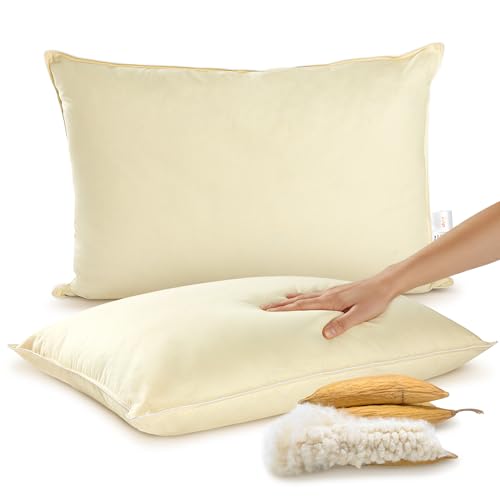
Cheer Collection Organic Kapok Bed Pillows (Set of 2, Standard)
It has the give of down without quills working their way through the shell, and getting two pillows for under sixty dollars made trying kapok an easy decision.
Kapok settles, so it needs shaking out far more often than foam does, and the listing names no third-party testing to point at.
Kapok is the plant fibre people reach for when they want the feel of down without the bird. The maker describes it as lighter and more breathable than cotton or wool, and describes the feel as down-like softness with gentle firmness. The build is simple: 100% kapok inside a 100% cotton shell, sold as a set of two 20 x 28 inch standard pillows for $59.99 as of August 2026 — which makes it the cheapest per-pillow way here to try a plant fill.
One claim we are setting aside. The maker states that the pillow provides support "without any chemicals". Treat that as marketing rather than a finding: it is not a certification, no third-party mark is named in the listing we sourced, and everything is made of chemicals. Buy this one for what it is made of, not for what the copy says about it.
YOUR MOON Natural Soft Wool Pillow (Queen, Set of 2)

Out of the bag it was a pancake, and forty minutes in the dryer brought it back to full height exactly as the instructions promised.
Half the fill is microfiber, which matters if you were shopping for pure wool, and the gusseted height is a lot of pillow for a back sleeper.
Read the fill percentages before anything else: 51% Australian wool and 49% microfiber. This is a wool blend, not a pure wool pillow, and the price reflects that — $85.99 as of August 2026 for a set of two queens. Anyone shopping specifically for an all-wool fill should keep looking.
Taken as a blend it is a strong pick for side sleepers. It measures 20 x 30 inches with a 3.2-inch gusset the maker says helps it resist flattening, which is exactly the geometry that keeps a broad shoulder from collapsing a pillow. The cover is 100% cotton and the maker says all materials are OEKO-TEX certified. It ships vacuum packed, and the maker recommends 30 to 40 minutes in a low or medium dryer before first use to restore the loft.
LOFE Organic Buckwheat Pillow with Organic Cotton Pillowcase

I poured out about a third of the hulls and finally have a firm pillow that holds its shape until morning instead of collapsing by 2 a.m.
The rustling is real — my partner noticed it before I did — and the hulls smelled faintly of hay for the first week or so.
Buckwheat is the oldest adjustable pillow there is, and the most literal: you set the height by pouring hulls in or out through a side zipper. The fill is tartary buckwheat hulls, which LOFE says are heat-treated before packing, and the shell is 100% organic cotton with an extra organic cotton pillowcase included. At $38.99 as of August 2026 it is the cheapest pick here.
We appreciate that LOFE names the two things people return buckwheat pillows over instead of burying them: it rustles when you move, and the hulls carry a faint natural odour. Both are inherent to the fill rather than defects, and both are easier to accept when you were warned. This is a firm pillow that stays where you put it, which some sleepers love and others cannot tolerate for a single night.
How to Read a Pillow Listing in Five Minutes
Most of the work in this category is reading, not shopping. Five minutes on a listing will tell you more than an hour of comparing marketing copy.
Non-Toxic Pillow FAQ
What are non-toxic pillows made of? In practice, the category covers pillows built from a small number of nameable materials — natural latex, kapok, wool, buckwheat hulls, cotton, or polyurethane foam that carries emissions testing — usually under a cotton shell, and usually without a stain- or water-resistant finish. It is a description of what has been left out and what has been tested, not a regulated product class.
Does an OEKO-TEX label mean a pillow is PFAS-free? No, and OEKO-TEX says so itself: certification means the product has been tested for the substances on its list, and OEKO-TEX does not certify a product as "PFAS-free". OEKO-TEX bans the intentional use of PFAS across its certifications and, per its partner institute Hohenstein, requires certified products to meet a limit of 25 ppb for each regulated PFAS substance as of 1 January 2026, with the total fluorine limit dropping from 100 ppm to 50 ppm during 2026.
How long does a new pillow smell last? For foam, plan on days rather than weeks. In a 2022 study in Chemosphere, VOC concentrations from two new memory foam mattresses peaked on the first day and then decayed, with short-term emission half-lives of roughly 4 to 12 hours and a long-term half-life of about 24 days. A pillow is a small fraction of a mattress's mass, so we would expect a shorter, smaller version of the same curve.
Are memory foam pillows toxic? The peer-reviewed work we can find on the closest comparable product does not support that framing. The same Chemosphere study reported that the concentrations measured and modelled were "well below available health-based benchmarks" and concluded that it was unlikely the mattress models evaluated "would pose a health risk to consumers." That is two mattresses, not every foam product on the market — but it is the evidence that exists.
Do pillows have to contain flame retardants? No. The federal mattress flammability standard at 16 CFR 1632 explicitly excludes pillows from its definition of a mattress, so a standard bed pillow has no federal flammability test to pass and no regulatory reason to carry a flame retardant.
Are these pillows safe for a baby? Do not put any pillow in an infant's sleep space. The American Academy of Pediatrics recommends keeping pillows and other soft objects and loose bedding out of the sleep area for at least the first 12 months, and pediatric guidance commonly points to waiting until around age two before introducing a pillow at all. Ask your pediatrician about your own child.
When should I talk to a clinician? If you develop a rash, wheeze, headaches or any other symptom you associate with new bedding, stop using it and see a clinician. We can tell you what a pillow is made of and what has been tested; we cannot tell you what is happening to you.
Why you can trust us

Aimee Cannon
Sleep & bedding writer
Aimee Cannon is a sleep and bedding writer who has spent years testing pillows of every kind — memory foam, down, wool, bamboo, buckwheat, and specialty support pillows. She focuses on matching the right pillow to each sleeping position and need, and reports what actually holds up after months of nightly use. When she is not testing pillows, Aimee is usually with her husband and her dog.